<?xml version="1.0" encoding="utf-8"?>
<feed xmlns="http://www.w3.org/2005/Atom">
    <title><![CDATA[Professional articles — Maciej Łebkowski — A professional Software Engineer]]></title>
    <link href="https://lebkowski.name/feed/professional.xml" rel="self"/>
    <link href="https://lebkowski.name/professional/"/>
    <updated>2026-03-31T07:23:49+00:00</updated>
    <id>https://lebkowski.name/professional</id>
            <author>
            <name><![CDATA[Maciej Łebkowski]]></name>            <email><![CDATA[m.lebkowski@gmail.com]]></email>        </author>
        <generator uri="http://sculpin.io/">Sculpin</generator>

                <entry>
            <title type="html"><![CDATA[High-level testing: A Chargebee integration case study]]></title>
            <link href="https://lebkowski.name/high-level-testing/"/>
            <updated>2026-03-28T00:00:00+00:00</updated>
            <id>https://lebkowski.name/high-level-testing</id>
            <summary>High-level tests such as functional or acceptance suites 
aren’t that different from simple unit tests. A case study
of real-life implementation.
</summary>            <content type="html"><![CDATA[<p class="post-body__p">In a <a href="/turtle" class="post-body__a">previous article</a>, I focused on the lowest level of the test pyramid, the unit tests. Today, I’ll move to the other end of the spectrum and show some examples of how to build high-level tests.</p>

<h2 id="what-is-a-high-level-test" class="post-body__h2 post-body__heading">What is a high-level test?</h2>

<p class="post-body__p">To get it out of the way, there are multiple types of high-level tests. You might have heard names like <em class="post-body__em">functional</em>, <em class="post-body__em">acceptance</em>, <em class="post-body__em">end-to-end</em>, and more. The distinction might be important to a particular team, but it’s not relevant to this article, so I won’t focus on their differences. The common thing between them is that they are approaching a larger system as a whole, and in particular, I will be using an HTTP API as an example, and my testing surface will be the request/response level. What’s also very important is that I won’t be doing a full end-to-end test, since parts of it I will want to replace with test doubles.</p>

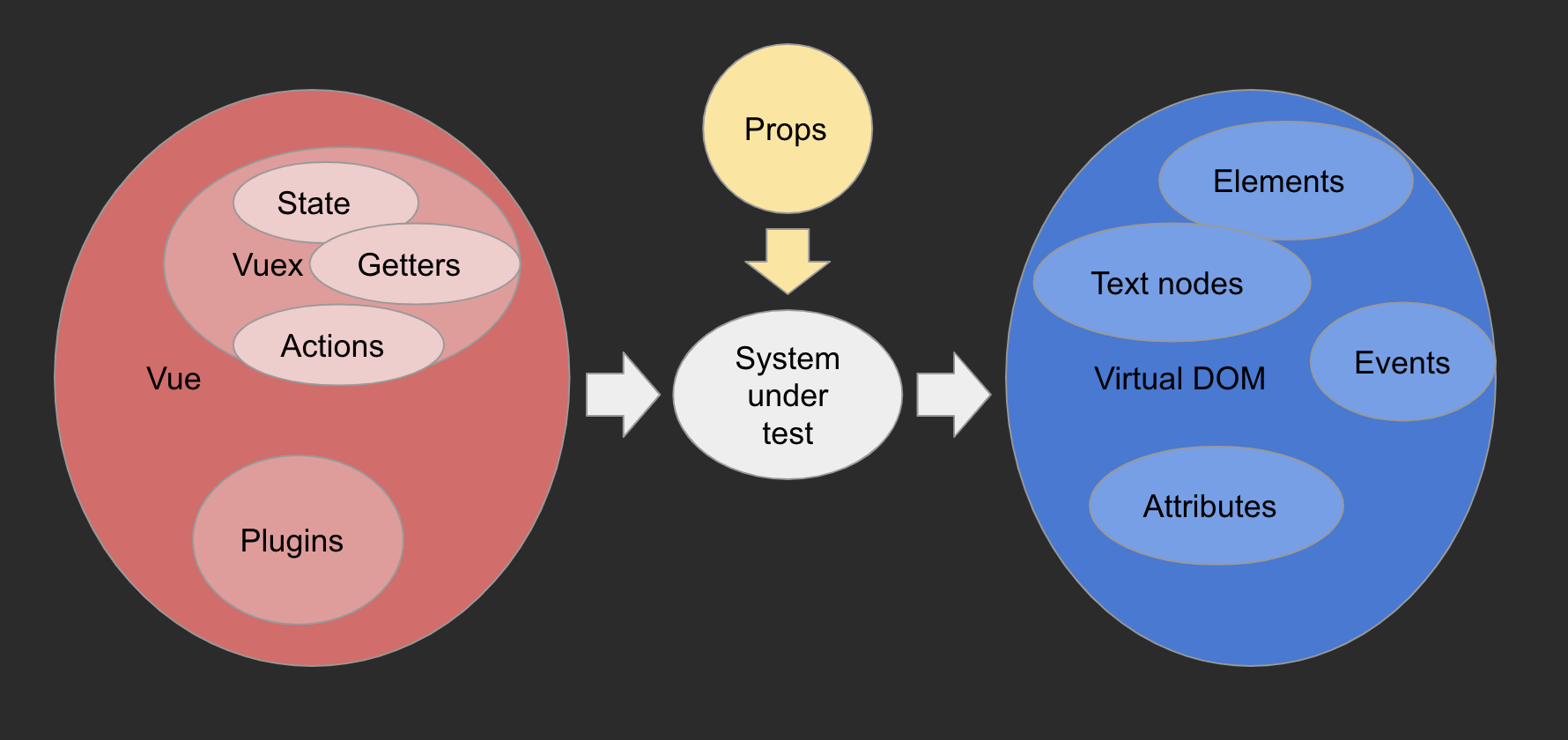
<p class="post-body__p">In principle, these tests aren’t that different from unit tests. That might feel controversial, but bear with me. I described the system under unit test in the following way:</p>

<p class="post-body__p"><img src="https://lebkowski.name/assets/images/high-level-testing/sut.png?61294d" alt="" class="post-body__img"></p>

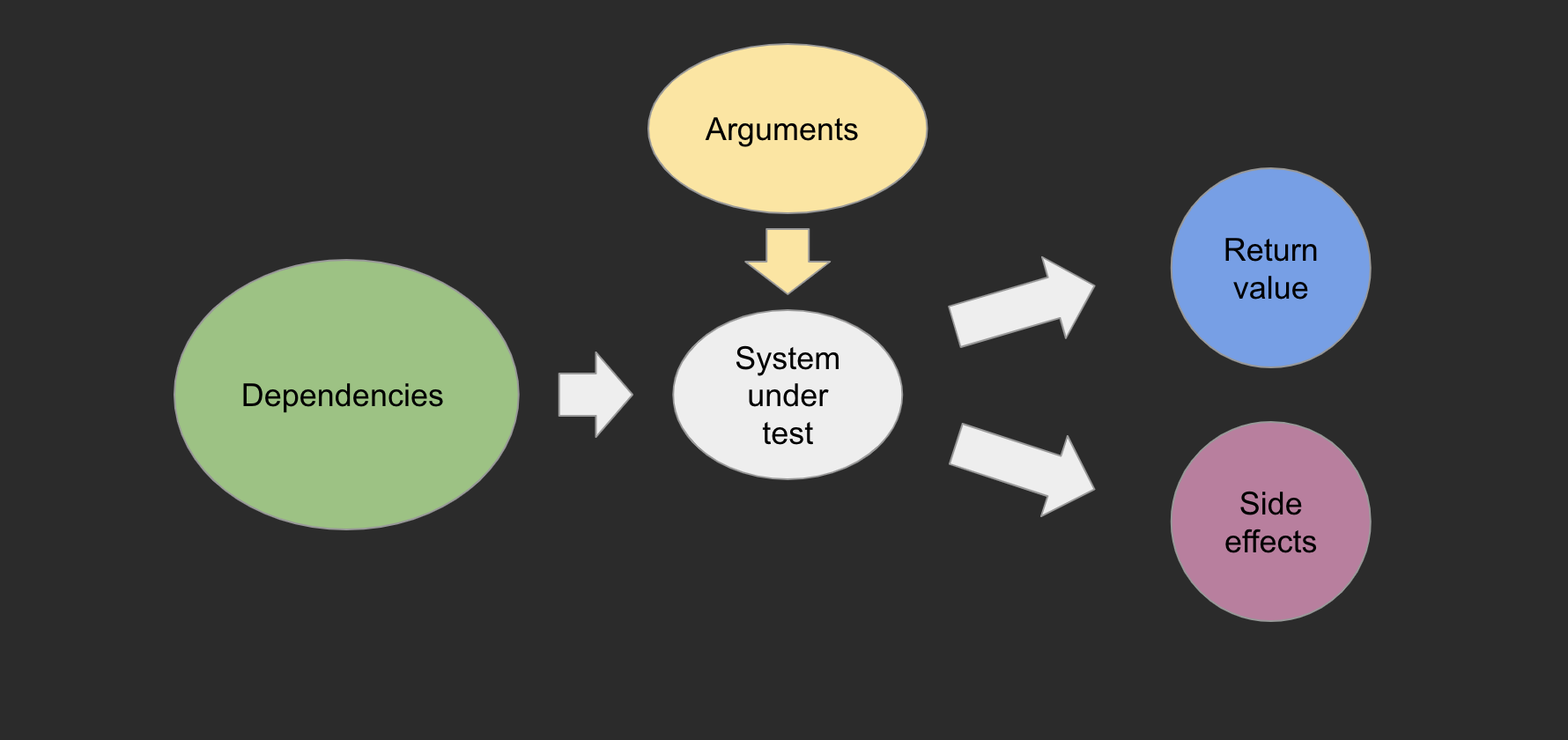
<p class="post-body__p">That looks similar when we treat our HTTP API Application as a black-box. Let me fill in more specific names on this same diagram:</p>

<p class="post-body__p"><img src="https://lebkowski.name/assets/images/high-level-testing/sut-http-api.png?f44f96" alt="" class="post-body__img"></p>

<p class="post-body__p">The public-facing interface of the app is an HTTP endpoint taking a request and returning a response. After changing state, for example, by creating a record, we may query the list endpoint for the same record type to verify the expected side effects (in other words, we check if the record was created). On top of that, there might be other side effects which are not as directly observed — when the app needs to communicate with a 3rd party, calling an API, sending an email, putting a message on a broker, or others.</p>

<p class="post-body__p">The model is the same, but the black-box under testing is larger.</p>

<h2 id="how-to-deal-with-a-larger-black-box" class="post-body__h2 post-body__heading">How to deal with a larger black-box?</h2>

<p class="post-body__p">This is the most crucial distinction, in my opinion. For unit tests, usually there are fewer dependencies, the context it operates on is smaller, inputs and outputs tend to be simpler, and the number of possible expected side-effects is more limited. For an HTTP API, the background context is really vast. Actually, it’s your entire application. The input/output layer is vague — it’s just an HTTP request, which seems simple — it’s just a set of headers and a request body, but that simple format can represent enormously complex scenarios. Your use cases will also probably consist of more than a single call to be meaningfull.</p>

<p class="post-body__p">This means that for a better developer experience, we need to put more effort into handling these inputs and outputs, as well as have more advanced methods of controlling the context. That’s a topic for a separate article, but I’ll just tease that it’s best to create a whole separate <em class="post-body__em">testing SDKs</em> for your app, a separate one for each of the actors interacting with your application. That might be an <code class="post-body__code">AdminSdk</code>, an <code class="post-body__code">AuthenticatedUserSdk</code>, but also  <code class="post-body__code">ChargebeeWebhookSdk</code>, or <code class="post-body__code">CronSdk</code>, or <code class="post-body__code">MessageBrokerSdk</code>. These represent different actors or agents interacting with your app, and encapsulate common behaviour (for example: the webhook SDK will automatically sign requests, so you don’t need to be bothered by it in your test case). We will use those to improve the readability and reuse of our test. Similarly, instead of making direct assertions on the HTTP response bodies or headers, it’s useful to wrap them in a dedicated assertion classes to add semantic meaning, better messages, and hide away the complexity in the tests.</p>

<p class="post-body__p">I’m not inventing an entirely new concept here. In the world of e2e testing, a similar pattern is commonly known as the <a href="https://www.selenium.dev/documentation/test_practices/encouraged/page_object_models/" class="post-body__a">Page Object Model</a>.</p>

<p class="post-body__p">You can explore <a href="https://github.com/WonderNetwork/slim-kernel-testing-harness" class="post-body__a"><code class="post-body__code">WonderNetwork/slim-kernel-testing-harness</code></a> as a library implementing these concepts.</p>

<h2 id="chargebee-case-study" class="post-body__h2 post-body__heading">Chargebee case study</h2>

<p class="post-body__p">Let’s see a practical example on how to test a real application, with some legacy problems, suboptimal architectural decisions, and a 3rd party API integration. This is based on a real modernization of a Chargebee integration I was recently performing. The app was using the <code class="post-body__code">chargebee/chargebee-php:^3</code> package, and because some orchestration around how it was used was changing, I wanted to add automated tests to have more confidence that the expected behaviour did not change.</p>

<p class="post-body__p">One of the use cases was quite simple:</p>

<blockquote class="post-body__blockquote">
  <p class="post-body__p">when a user changed their company name in the account panel, the change should be reflected in their Chargebee customer</p>
</blockquote>

<p class="post-body__p">The left part of the diagram — input/output — is quite simple. I already had a use case facade for the company administrators, which handled the authentication and exposed simple methods to call the different endpoints. I simply added another one to call the <code class="post-body__code">PATCH</code> endpoint to change the company name, and an assertion to test that the response is successful and contains the new value. Simplified, this could look something like this:</p>

<p class="post-body__p"><a href="https://gist.github.com/mlebkowski/ccc7c6bf92d04d619a310c865024f96e?file=company-scenario.php" class="post-body__a"></a></p>

<pre class="post-body__pre"><code class="post-body__code">function changeCompanyName(string $name): void {
  $response = PatchCompanyEndpointAssertion::of(
    $this-&gt;httpClient-&gt;patch('/api/company', ['name' =&gt; $name]),
  );
  $response-&gt;assertSuccessful();
  $response-&gt;assertName($name);
}
</code></pre>

<h2 id="the-right-part-of-the-diagram-is-trickier" class="post-body__h2 post-body__heading">The right part of the diagram is trickier</h2>

<p class="post-body__p">The left side was easy. I can even add another check to verify the observable state, and check that the new name was persisted in the database, by querying a <code class="post-body__code">GET</code> endpoint for the company. But there are also expectations about outgoing messages: side-effects made on the Chargebee API. When writing a unit test, we would use the <a href="http://localhost:8000/turtle/#using-spies-and-testing-exceptions" class="post-body__a">spy pattern</a> to check these.</p>

<p class="post-body__p">How to inject a spy into an entire application? Well, your framework usually <a href="https://symfony.com/doc/current/testing.html#set-up-your-test-environment" class="post-body__a">affords methods to provide customized configuration for tests</a>, or even <a href="https://symfony.com/doc/current/testing.html#mocking-dependencies" class="post-body__a">mock some of the dependencies at runtime</a>, so that’s not a problem.</p>

<p class="post-body__p">Unfortunately, the default way of configuring and using Chargebee in the v3 SDK is by registering a static, global <code class="post-body__code">Environment</code> instance. This allows you to then call different endpoints all across your codebase, without using dependency injection. And this was the case for my application as well.</p>

<p class="post-body__p">The next best thing would be to replace the HTTP client used by the SDK and provide a <a href="https://docs.guzzlephp.org/en/stable/testing.html" class="post-body__a">mock handler</a>, but the package hardcoded the calls and didn’t expose a way of doing that either.</p>

<p class="post-body__p">To start, this is how my app looked from a helicopter view:</p>

<p class="post-body__p"><img src="https://lebkowski.name/assets/images/high-level-testing/chargebee-static.png?41a685" alt="" class="post-body__img"></p>

<h2 id="isolate-all-calls-to-a-single-facade" class="post-body__h2 post-body__heading">Isolate all calls to a single facade</h2>

<p class="post-body__p">There was no practical way of replacing the Chargebee integration with a test double. The first order of business was to improve that situation. Instead of making these calls <em class="post-body__em">ad hoc</em> in any class, the goal was to <strong class="post-body__strong">move all the uses of Chargebee endpoints to a single facade</strong>, which then could be replaced with a test double.</p>

<p class="post-body__p">There was a lot of moving around, and along the way, I needed to separate any business logic around those calls. The goal is to replace that facade in tests, so I wanted as little business logic to be mocked, and preferably <em class="post-body__em">only the Chargebee integration</em>.</p>

<p class="post-body__p">The final result looked something like this:</p>

<p class="post-body__p"><img src="https://lebkowski.name/assets/images/high-level-testing/chargebee-sdk.png?d6abab" alt="" class="post-body__img"></p>

<p class="post-body__p">All the calls are grouped in one place. I specifically placed it on the edge of the domain area, because <a href="https://www.wikiwand.com/en/Hexagonal_architecture_(software)#Principle" class="post-body__a">it’s a port</a> — a window our application can explicitly use to communicate with the outside world. And through that window, we can pass in different adapters. It will be a Chargebee API client for production, but an in-memory test double for our high-level test:</p>

<p class="post-body__p"><img src="https://lebkowski.name/assets/images/high-level-testing/chargebee-test-double.png?e1f171" alt="" class="post-body__img"></p>

<h2 id="implementing-the-test-double" class="post-body__h2 post-body__heading">Implementing the test double</h2>

<p class="post-body__p">The previous efforts allowed me to finally replace a single dependency in my test environment to mock all the communication with Chargebee. This isn’t a simple task, because not only are there many methods exposed on that facade (both the actual API and the test double split their responsibility into many different classes), but we also need to accurately simulate the real API behaviour and state changes. The better we do it, the more reliable our test will become.</p>

<p class="post-body__p">As an example, for our company name change use case, here’s a partial implementation that would allow us to finish the test:</p>

<p class="post-body__p"><a href="https://gist.github.com/mlebkowski/ccc7c6bf92d04d619a310c865024f96e?file=chargebee-customer-endpoint-test-double.php" class="post-body__a"></a></p>

<pre class="post-body__pre"><code class="post-body__code">final class ChargebeeCustomerEndpointTestDouble {
  private array $customers = [];

  public function givenCustomerExists(Customer $customer): void {
    $this-&gt;customers[$customer-&gt;id] = $customer;
  }

  public function updateCustomer(CustomerId $id, CustomerChangePayload $change): void {
    $this-&gt;customers[$id-&gt;value] = $this-&gt;get($id)-&gt;withName($change-&gt;name);
  }

  public function get(CustomerId $id): Customer {
    return $this-&gt;customers[$id-&gt;value] ?? throw new CustomerNotFoundException();
  }
}
</code></pre>

<p class="post-body__p">The first method is an internal one used only in tests. It allows us to short-circuit our scenario and start it in a hypothetical situation where the customer already exists, instead of going through all the steps from the start. A different team might very well choose not to use shortcuts and simulate the entire journey, starting with a blank slate.</p>

<p class="post-body__p">The following two methods are used by the facade, or maybe they are even part of the interface, i.e., they are called by our domain code. They are responsible for recreating the same logic that happens when we call the Chargebee API. In an advanced use case, this would be more complicated: for example, it would allow you to simulate exceptional conditions, errors, missing data, etc.</p>

<p class="post-body__p">Putting that test double into the test container, our test case can be completed.</p>

<p class="post-body__p"><a href="https://gist.github.com/mlebkowski/ccc7c6bf92d04d619a310c865024f96e?file=company-name-test.php" class="post-body__a"></a></p>

<pre class="post-body__pre"><code class="post-body__code">#[Test]
function companyNameChangeIsReflectedInChargebee(): void {
   // given we set up the pre-existing context:
   $companyScenario = $this-&gt;companyUseCase-&gt;givenCompanyExists("Evil Corp");
   $this-&gt;chargebeeUseCase-&gt;givenCustomerExists(
     new Customer(
       id: $companyScenario-&gt;companyId, 
       name: "Evil Corp",
     ),
   );
   // when the API is called
   $companyScenario-&gt;changeCompanyName("Acme");
   // then expect the side-effect was produced by inspecting our test double
   $actual = $this-&gt;chargebeeUseCase-&gt;getCustomer($customer-&gt;companyId);
   self::assertSame("Acme", $actual-&gt;name);
}
</code></pre>

<h2 id="testing-one-last-assumption" class="post-body__h2 post-body__heading">Testing one last assumption</h2>

<p class="post-body__p">The test case shows that given some context (customer exists), when an input is applied (HTTP request to the correct API endpoint), a response is produced, and some state change can be observed (response from a separate endpoint), and a side-effect was produced on a Chargebee port. But I explicitly excluded the real implementation of the 3rd party integration from this scenario. I can be confident that 95% of the code works, but I have no idea if the last part is correct.</p>

<p class="post-body__p">Let’s flip the scenario and test the SDK itself. Remember, it didn’t allow us to provide a test double for the HTTP client, so we’ll resort to using a real API. Well, kind of. <a href="https://wiremock.org/" class="post-body__a">WireMock</a> is great at pretending to be the real thing. It allows us to register a set of mappings — a collection of endpoints and a list of conditions to match a request — and associate them with
predefined responses. For all intents and purposes, we can make WireMock behave exactly the same as the Chargebee API for the inputs we give it.</p>

<p class="post-body__p">By placing a <a href="https://proxyman.com/" class="post-body__a">capturing proxy</a> in front of my application, I was able to methodically collect all the real requests and responses the system makes to the Chargebee API, and use them in an integration test of the SDK I implemented, cementing its behaviour.</p>

<p class="post-body__p"><img src="https://lebkowski.name/assets/images/high-level-testing/chargebee-wiremock.png?6aa957" alt="" class="post-body__img"></p>

<p class="post-body__p">With this pair of tests:</p>

<ul class="post-body__ul">
<li class="post-body__li">One high-level, using a Chargebee Test Double, covering 95% of the application’s „<em class="post-body__em">area</em>”</li>
<li class="post-body__li">And a second one on a lower level, targeting just a single unit and a very fast mock API</li>
</ul>

<p class="post-body__p">We have covered the entirety of the code paths required for our feature.</p>

<h2 id="final-bonus" class="post-body__h2 post-body__heading">Final bonus</h2>

<p class="post-body__p">After all of the above was done, and I could be pretty certain my application works as intended, I moved one step further. I upgraded the deprecated version 3 of the Chargebee SDK package. At this point, it was fairly easy because of the following facts:</p>

<ul class="post-body__ul">
<li class="post-body__li">All usages of the <code class="post-body__code">ChargeBee\</code> namespace was limited to my one facade, so I knew all the changes would be contained to that one place (yes, I mapped all of the inputs and outputs of my facade to my own value objects).</li>
<li class="post-body__li">The new package version had some implementation changes, but it still used the same API, so I knew the inputs and outputs were the same, and the HTTP calls were also unchanged.</li>
</ul>

<p class="post-body__p">After I reimplemented the facade (Chargebee v4 is quite a breaking change, as it fundamentally changes the architecture of the SDK), I was able to rerun the integration test, expecting it to pass with flying colors. After fixing two mistyped parameters, I confirmed exactly that: the documented behaviours were exactly the same when using the v4 implementation, and I could safely merge that change too.</p>

<h2 id="closing-thoughts" class="post-body__h2 post-body__heading">Closing thoughts</h2>

<p class="post-body__p">As you were able to see, a high-level test doesn’t need to be that different from a unit test. There is more boilerplate to keep it manageable, and to hide away the complexity and area of the affected context, but in the end, the test case follows the same principles:</p>

<ul class="post-body__ul">
<li class="post-body__li">Arrange (prepare a bunch of stuff), Act (execute our scenario), Assert (check for its effects)</li>
<li class="post-body__li">We check responses, we check observable state change, and we check side-effects produced on the outside of our black-box, but we never need to look inside it</li>
</ul>

<p class="post-body__p">If you haven’t already, you can read more of my <a href="/testing" class="post-body__a">articles about testing</a>, including some other case studies, or a detailed chapter focusing on unit tests. And if you need that kind of support, find out <a href="/offer/consulting" class="post-body__a">how I can help your project</a>.</p>
]]></content>
        </entry>
            <entry>
            <title type="html"><![CDATA[Remote sudo password using 1password (or any other password manager)]]></title>
            <link href="https://lebkowski.name/sudo/"/>
            <updated>2025-02-23T00:00:00+00:00</updated>
            <id>https://lebkowski.name/sudo</id>
            <summary>Using your local password manager to authenticate with remote sudo over ssh</summary>            <content type="html"><![CDATA[<p class="post-body__p">Having a local, secure and passwordless sudo is easy, especially <a href="https://apple.stackexchange.com/questions/259093/can-touch-id-on-mac-authenticate-sudo-in-terminal" class="post-body__a">with apples built in biometrics support</a>. But what if most of your sudo prompts are on a remote machine you ssh into? Well, we can set this up too.</p>

<h2 id="prerequisites" class="post-body__h2 post-body__heading">Prerequisites</h2>

<ul class="post-body__ul">
<li class="post-body__li">We have a set of target hosts we SSH into and escalate our privileges using sudo, which requires a password</li>
<li class="post-body__li">You have some kind of secure password manager on your local machine. I’ll be using 1password on a mac, but the solution is more general than that.</li>
</ul>

<h2 id="the-problem" class="post-body__h2 post-body__heading">The problem</h2>

<p class="post-body__p">Our initial setup looks like this:</p>

<ul class="post-body__ul">
<li class="post-body__li">We SSH into a remote machine</li>
<li class="post-body__li">Call <code class="post-body__code">sudo whatever</code></li>
<li class="post-body__li">We need to type a password</li>
</ul>

<p class="post-body__p"><img src="https://lebkowski.name/assets/images/sudo/initial.svg?6cde2a" alt="" class="post-body__img"></p>

<p class="post-body__p">And our target architecture is the following:</p>

<ul class="post-body__ul">
<li class="post-body__li">We SSH into a remote machine</li>
<li class="post-body__li">Call <code class="post-body__code">sudo --askpass whatever</code></li>
<li class="post-body__li">Behind the scenes, your password manager is queried for password, and you grant access using your regular method, and it gets delivered to sudo</li>
</ul>

<p class="post-body__p">I don’t want to spoil too much, but our solution will include defining <code class="post-body__code">SUDO_ASKPASS</code>, an askpass script, ssh tunnel between two separate sockets, a script to talk to the password manager and a sprinkle of some configuration on top. Let’s get to it.</p>

<p class="post-body__p"><img src="https://lebkowski.name/assets/images/sudo/target.svg?1e148d" alt="" class="post-body__img"></p>

<h2 id="creating-a-script-to-print-the-password-on-stdout" class="post-body__h2 post-body__heading">Creating a script to print the password on <code class="post-body__code">stdout</code></h2>

<p class="post-body__p">This is the simples part. Just use whatever scripting or compiled language to fetch a specific password from your vault and dump it to standard output. I use 1password, so I’ll make use of <a href="https://developer.1password.com/docs/cli/get-started/" class="post-body__a">1Password CLI</a> utility called <code class="post-body__code">op</code>:</p>

<p class="post-body__p"><a href="https://gist.github.com/mlebkowski/5787e55f130ab1af55f34ed548db8784?file=op-sudo.sh" class="post-body__a"></a></p>

<pre class="post-body__pre"><code class="post-body__code">#!/usr/bin/env bash

main() {
  declare account="$1" uuid="$2" field="${3:-password}"
  /opt/homebrew/bin/op read --account "$account" "op://Employee/$uuid/$field"
}

main "$@"
</code></pre>

<p class="post-body__p">Since the script will not be executed from my login shell, I passed the full path to the op binary (as found by <code class="post-body__code">command -v op</code>), because my <code class="post-body__code">$PATH</code> settings will not be present in that context.</p>

<p class="post-body__p">I have my password saved in a work account, so my default vault is named <code class="post-body__code">Employee</code>. I got the item uuid from 1Password app. You can learn more about <a href="https://developer.1password.com/docs/cli/secret-reference-syntax/" class="post-body__a">secret reference syntax</a> to adjust to your context.</p>

<p class="post-body__p">Let’s confirm that it works. After I saved this to <code class="post-body__code">~/bin/op-sudo.sh</code> and adding necessary permisions <code class="post-body__code">chmod a+x op-sudo.sh</code>:</p>

<p class="post-body__p"><img src="https://lebkowski.name/assets/images/sudo/op-sudo.png?818b83" alt="" class="post-body__img"></p>

<p class="post-body__p">Everything works fine. The password manager asks me for confirmation first, and the password is printed on stdout.</p>

<h2 id="setting-up-a-launchagent-inetd-to-listen-on-a-socket" class="post-body__h2 post-body__heading">Setting up a LaunchAgent (inetd) to listen on a socket</h2>

<p class="post-body__p">This next part will create a local socket, that will map to the script we just created. On linux machines there was this thing called <a href="https://www.wikiwand.com/en/articles/Inetd" class="post-body__a"><code class="post-body__code">inetd</code></a> which opened a port for us, listened for connections, and mapped the script’s stdio to the socket. Today, I guess <a href="https://www.freedesktop.org/software/systemd/man/latest/systemd.socket.html" class="post-body__a">systemd can do that</a>, and here’s <a href="https://mgdm.net/weblog/systemd-socket-activation/" class="post-body__a">a person describing how to set that up</a>.</p>

<p class="post-body__p">I am using a macOs machine instead, so I will create a <a href="https://developer.apple.com/library/archive/documentation/MacOSX/Conceptual/BPSystemStartup/Chapters/CreatingLaunchdJobs.html" class="post-body__a">LaunchAgent</a> instead. LaunchAgents use a very similar concept, but they are configured via XML instead. Fill in some blanks in the following config and save it in <code class="post-body__code">~/Library/LaunchAgents</code> with a <code class="post-body__code">plist</code> extension. I used the name <code class="post-body__code">pl.narzekasz.op-sudo.plist</code>.</p>

<p class="post-body__p"><a href="https://gist.github.com/mlebkowski/5787e55f130ab1af55f34ed548db8784?file=pl.narzekasz.op-sudo.plist" class="post-body__a"></a></p>

<pre class="post-body__pre"><code class="post-body__code">&lt;?xml version="1.0" encoding="UTF-8"?&gt;
&lt;!DOCTYPE plist PUBLIC "-//Apple Computer//DTD PLIST 1.0//EN" "http://www.apple.com/DTDs/PropertyList-1.0.dtd"&gt;
&lt;plist version="1.0"&gt;
&lt;dict&gt;
    &lt;key&gt;Disabled&lt;/key&gt;
    &lt;false/&gt;
    &lt;key&gt;Label&lt;/key&gt;
    &lt;string&gt;pl.narzekasz.op-sudo.35s524did7b74qggqeoqbetpee&lt;/string&gt;
    &lt;key&gt;ProgramArguments&lt;/key&gt;
    &lt;array&gt;
        &lt;string&gt;/Users/puck/bin/op-sudo.sh&lt;/string&gt;
        &lt;string&gt;WonderNetwork&lt;/string&gt;
        &lt;string&gt;35s524did7b74qggqeoqbetpee&lt;/string&gt;
    &lt;/array&gt;
    &lt;key&gt;inetdCompatibility&lt;/key&gt;
    &lt;dict&gt;
        &lt;key&gt;Wait&lt;/key&gt;
        &lt;false/&gt;
    &lt;/dict&gt;
    &lt;key&gt;InitGroups&lt;/key&gt;
    &lt;true/&gt;
    &lt;key&gt;Sockets&lt;/key&gt;
    &lt;dict&gt;
        &lt;key&gt;Listeners&lt;/key&gt;
        &lt;dict&gt;
            &lt;key&gt;SockPathMode&lt;/key&gt;
            &lt;integer&gt;384&lt;/integer&gt;
            &lt;key&gt;SockPathName&lt;/key&gt;
            &lt;string&gt;/Users/puck/.op-sudo/wondernetwork.sock&lt;/string&gt;
            &lt;key&gt;SockType&lt;/key&gt;
            &lt;string&gt;stream&lt;/string&gt;
        &lt;/dict&gt;
    &lt;/dict&gt;
&lt;/dict&gt;
&lt;/plist&gt;
</code></pre>

<p class="post-body__p">There are some key placeholders there you need to pay attention to:</p>

<ul class="post-body__ul">
<li class="post-body__li">I used a pl.narzekasz.pl.op-sudo.{id} Label, because I anticipate I might have more such configurations to serve different passwords. This does not matter that much.</li>
<li class="post-body__li"><p class="post-body__p">The ProgramArguments is an array representing the command invokation, so it contains the full path to the script as well as its arguments (1password account and item uuid). There’s nothing stopping you to call <code class="post-body__code">op</code> directly here instead of having an intermediate script:</p>

<pre class="post-body__pre"><code class="post-body__code">&lt;string&gt;/opt/homebrew/bin/op&lt;/string&gt;
&lt;string&gt;--account&lt;/string&gt;
&lt;string&gt;WonderNetwork&lt;/string&gt;
&lt;string&gt;read&lt;/string&gt;
&lt;string&gt;op://Employee/{place-your-id-here}/{field}&lt;/string&gt;
</code></pre></li>
<li class="post-body__li"><p class="post-body__p">And at the bottom there’s <code class="post-body__code">SocketPathName</code> defining a path to the unix domain socket that will be used to listen for incomming connections. Make sure to create the directory first, or the agent won’t start: <code class="post-body__code">mkdir /Users/puck/.op-sudo</code></p></li>
</ul>

<p class="post-body__p">Finally, we need to launch the agent:</p>

<pre class="post-body__pre"><code class="post-body__code">launchctl load ~/Library/LaunchAgents/pl.narzekasz.op-sudo.plist
</code></pre>

<p class="post-body__p">And I will use <code class="post-body__code">socat</code> to confirm that I can get the password using the specified socket:</p>

<p class="post-body__p"><img src="https://lebkowski.name/assets/images/sudo/socat.png?988991" alt="" class="post-body__img"></p>

<h2 id="creating-a-tunnel-to-the-socket" class="post-body__h2 post-body__heading">Creating a tunnel to the socket</h2>

<p class="post-body__p">Now, we need to somehow transfer that socket to the remote host. Fortunately, we can simply use ssh remote forwarding for that. I will quickly show how to do that by opening a TCP port of target machine, which is less secure, because every user on that system will be able to access it. That’s not a huge issue, since the script asks for confirmation each time, but it’s better if we can avoid that.</p>

<h3 id="using-a-tcp-port" class="post-body__h3 post-body__heading">Using a TCP port</h3>

<p class="post-body__p">The way we connect would be:</p>

<pre class="post-body__pre"><code class="post-body__code">ssh -R 7825:/Users/puck/.op-sudo/wondernetwork.sock target-host
</code></pre>

<p class="post-body__p"><img src="https://lebkowski.name/assets/images/sudo/ssh-tcp.png?f2ea25" alt="" class="post-body__img"></p>

<p class="post-body__p">We’re good to go.</p>

<h3 id="using-a-unix-domain-socket" class="post-body__h3 post-body__heading">Using a Unix Domain socket</h3>

<p class="post-body__p">Let’s do that properly and permanently instead. Add the remote forwarding instruction to your <code class="ssh post-body__code">/config</code> for target host or group. And here’s the part where you can set up multiple launch agents, serving different passwords, listening on different sockets, forwarded to different remote machines.</p>

<pre class="post-body__pre"><code class="post-body__code">Host narzekasz.pl
  RemoteForward /home/puck/.ssh/op-sudo.sock /Users/puck/.op-sudo/wondernetwork.com
</code></pre>

<p class="post-body__p">We can confirm that this still works:</p>

<p class="post-body__p"><img src="https://lebkowski.name/assets/images/sudo/ssh-socket.png?245dca" alt="" class="post-body__img"></p>

<p class="post-body__p">There is one catch. The remote socket won’t be cleaned up by the <code class="post-body__code">sshd</code> after you disconnect, so a dead socket file will be left in the filesystem. And next time you try to connect: sshd will bail, because the target path already exists. This behaviour can be overriden using the <a href="https://unix.stackexchange.com/a/414376/16278" class="post-body__a"><code class="post-body__code">StreamLocalBindUnlink</code></a> option, unfortunately, this needs to be set in the <code class="post-body__code">sshd_config</code> of the <em class="post-body__em">target host</em>, which might be out of reach in many situations.</p>

<h2 id="final-piece-of-the-puzzle-sudo-askpass" class="post-body__h2 post-body__heading">Final piece of the puzzle: <code class="post-body__code">sudo-askpass</code></h2>

<p class="post-body__p">Finally, we need to tie this together with sudo on the remote host. We can use the <a href="https://stackoverflow.com/questions/12608293/how-to-setup-a-sudo-askpass-environment-variable" class="post-body__a"><code class="post-body__code">SUDO_ASKPASS</code></a> environment variable for this. First, let’s save a script that reads from our forwarded unix domain socket. You can use either netcat (<code class="post-body__code">nc</code>) or <a href="https://github.com/3ndG4me/socat" class="post-body__a"><code class="post-body__code">socat</code></a> for that, whatever is more convenient for you:</p>

<p class="post-body__p"><a href="https://gist.github.com/mlebkowski/5787e55f130ab1af55f34ed548db8784?file=sudo-askpass.sh" class="post-body__a"></a></p>

<pre class="post-body__pre"><code class="post-body__code">#!/usr/bin/env bash

has-command() {
  command -v "$1" &gt;/dev/null 2&gt;&amp;1
}

main() {
  SOCKET="$(realpath ~/.ssh/op-sudo.sock)"
  if has-command nc; then
    echo | nc -U "$SOCKET"
  elif has-command socat; then
    socat stdio "UNIX-CONNECT:$SOCKET"
  else
    echo "Type the passwords your own self" &gt;&amp;2
    return 1
  fi
}

main "$@"
</code></pre>

<p class="post-body__p">Save it to wherever, say <code class="post-body__code">~/bin/sudo-askpass</code> (remember to <code class="post-body__code">chmod a+x ~/bin/sudo-askpass</code>) and configure it in your <code class="bashrc post-body__code"></code>, <code class="zshrc post-body__code"></code> or similar:</p>

<pre class="post-body__pre"><code class="post-body__code">export SUDO_ASKPASS=~/bin/sudo-askpass
</code></pre>

<p class="post-body__p">Enjoy! Remember to run your sudo with <code class="post-body__code">--askpass</code> option!</p>

<p class="post-body__p"><img src="https://lebkowski.name/assets/images/sudo/sudo-askpass.gif?429975" alt="" class="post-body__img"></p>

<p class="post-body__p">Please leave likes and comments below to let me know if you enjoyed this instruction or have anything to improve</p>
]]></content>
        </entry>
            <entry>
            <title type="html"><![CDATA[Building a secure API Token mechanism]]></title>
            <link href="https://lebkowski.name/api-tokens/"/>
            <updated>2025-02-03T00:00:00+00:00</updated>
            <id>https://lebkowski.name/api-tokens</id>
            <summary>Improving a system from just accepting a static secret value to really secure API token mechanisms can be hard</summary>            <content type="html"><![CDATA[<p class="post-body__p">I am building a programmatic access to my website. Or maybe that’s just a fancy way of saying that I’m designing an API. Either way, one of the core elements of the project is the authentication method. I need a way of knowing who is the sender of any given message (API request).</p>

<p class="post-body__p">Since this is more of an experiment rather than a serious feature in a mature project, some corner-cutting was in order. In the initial draft, I just derived a single, static token based on the user ID. This would look something like this pseudocode (of course the secret would be generated once and stored):</p>

<pre class="post-body__pre"><code class="post-body__code">secret := random_bytes 32
hash := hash_hmac secret id
token := join "_" id hash
</code></pre>

<p class="post-body__p">Which then can be used in the following way:</p>

<pre class="post-body__pre"><code class="post-body__code">id, hash := split "_" token
verify = hash_hmac secret id
match verify == hash:
  true → id
  false → null
</code></pre>

<p class="post-body__p">The primary upside of that solution was that it worked, and it took about 5 minutes to implement. The obvious downside: it was only slightly more secure than attaching a „bro, trust me” to the payload.</p>

<h2 id="the-characteristics-of-a-static-api-token" class="post-body__h2 post-body__heading">The characteristics of a static API token</h2>

<p class="post-body__p">So, a lot of the web apps do this actually. Or at list a similar implementation, but for all intents and purposes, the results are the same. You navigate to the settings page, where you can find a single token you can use for authorization.</p>

<p class="post-body__p">Let’s examine its characteristics, and I’ll try to be generous:</p>

<ul class="post-body__ul">
<li class="post-body__li">✅ It does not try to roll out a fancy pseud-crypto algorithm to derive the value, it just calculates a message digest. That in itself allows us to avoid some common pitfalls, like a padding attack for example. And although, in all fairness, I don’t believe that using a padding attack would be feasible in this scenario, using some strong foundations is a good start</li>
</ul>

<p class="post-body__p">I think that is the only positive of this solution. I won’t even count implementation time, since I can’t imagine a world in which a few hours spared while implementing would outweigh the risks that it brings:</p>

<ul class="post-body__ul">
<li class="post-body__li">⛔ There is no way of revoking a token. Once it’s compromised, it’s game over. And I don’t even mean that <em class="post-body__em">the customer does not have that option in the UI</em>. Even I, as the system author, cannot do anything about that.</li>
<li class="post-body__li">⛔ In a similar vein, there is no expiration attached to a token. This means that once someone saves it somewhere, it has the potential to be valid 10 years from now, assuming the site is up and we didn’t migrate away from this authorization method.</li>
</ul>

<p class="post-body__p">I think that with little effort I can do significantly better.</p>

<h2 id="opaque-tokens" class="post-body__h2 post-body__heading">Opaque tokens</h2>

<p class="post-body__p">My first improvement would be replacing a single static token with a random, opaque secret stored in the database. Now, a user needs to request a new token, and the backend gladly generates one for them (and stores it in the database for later use).</p>

<p class="post-body__p">When attached to an API request, the backend would lookup the token in the database, verify that it exists and is valid, and use the stored <code class="post-body__code">userId</code> value.</p>

<p class="post-body__p">How does this fix the issues I mentioned a couple of paragraphs prior?</p>

<ul class="post-body__ul">
<li class="post-body__li">✅ Now the customer can simply have a section in their panel to manage the list of tokens. Each of them can simply be revoked at their request, and its database record removed. If a token gets compromised, it can get revoked (individually) and that random string or characters would lose any of its meaning.</li>
<li class="post-body__li">✅ Each token gets an expiration date. This might be 2 weeks, 3 months or a year, depending on your situation, but at least there is one, which means that by default, these tokens will not be valid indefinitely.</li>
</ul>

<p class="post-body__p">Great, what other upsides did we get out of the box?</p>

<ul class="post-body__ul">
<li class="post-body__li">✅ There can be multiple tokens at once. The customer can name them, give them different expiration dates, and possibly — even if that’s not the case for my app right now — attach specific permissions to each of them.</li>
<li class="post-body__li">✅ Each token will have a date of last request attached, so the user can determine if the token is in use or not</li>
</ul>

<p class="post-body__p">This is already <em class="post-body__em">much better</em>, and the effort to implement a simple system like that isn’t large. So far it seems like it pays off, but there is one glaring flaw.</p>

<h2 id="storing-raw-tokens" class="post-body__h2 post-body__heading">Storing raw tokens</h2>

<p class="post-body__p">While storing raw passwords in a database wouldn’t even cross my mind, when I first implemented the above mechanism, the fact that the raw token secrets were just sitting there didn’t make me flinch.</p>

<p class="post-body__p">I must admit, that storing raw passwords has some key differences:</p>

<ul class="post-body__ul">
<li class="post-body__li">Users <em class="post-body__em">remember</em> their passwords, so changing them is a chore. On the other hand, people <em class="post-body__em">store</em> the API tokens, so if we were to invalidate one, changing it would be a one-time activity without a lasting impact</li>
<li class="post-body__li">Users <em class="post-body__em">reuse</em> passwords, so a potential breach could impact much more than just our system</li>
<li class="post-body__li">And finally, API tokens would probably authorize you to access just a subset of areas in comparison to the account password, which would most likely grant access to every app’s feature</li>
</ul>

<p class="post-body__p">Either way, exposing raw API tokens in a breach would mean service disruption for your customers, as they would need to be revoked immediately. And depending on the circumstance, some of the tokens might have been already used, causing a wider breach. The optics of the situation is also not good: a leak might happen, but a good system architecture would put more safeguards in place, so the impact is minimised.</p>

<h2 id="hashing-token-secrets" class="post-body__h2 post-body__heading">Hashing token secrets</h2>

<p class="post-body__p">We could apply rules similar to storing passwords: just hash the value, and when a request comes in, hash that too and compare the hashes. There are some key differences that complicate things:</p>

<ul class="post-body__ul">
<li class="post-body__li">Passwords are usually attached to an account identifier (like a username or an email), which allows us to look up the correct hash to run <code class="post-body__code">password_verify input hash</code> on. Tokens, on the other hand, lack that and are mostly meant to work on their own. And since secure password hashing algorithms such as Argon2 generate salt in their output, we cannot simply hash the input and look it up, since each invocation of the hash function produces different outputs.</li>
<li class="post-body__li">The app wouldn’t know the secret value. You probably know all this prompts: copy the secret now, as this is the last time the app can show it to you. This is a key principle of this security architecture, and at the same time a huge UX downside.</li>
</ul>

<p class="post-body__p">Let’s pause to think before we make our next step</p>

<h2 id="gathering-requirements" class="post-body__h2 post-body__heading">Gathering requirements</h2>

<p class="post-body__p">Next steps wouldn’t be as simple as our first improvement. Basically now the paths split, and whichever one we take, there would be a compromise that we need to make. To help us with the decision, let’s decide on the requirements we have for our system.</p>

<p class="post-body__p">In my case, that would be:</p>

<ul class="post-body__ul">
<li class="post-body__li">Since the system is not processing any sensitive data, I can sacrifice some of the security guarantees for user convenience</li>
<li class="post-body__li">I would like to be able to present a token secret to the user at any point. If that’s not obvious, I would like to do that without regenerating its value (and invalidating the previously used one in the process)</li>
<li class="post-body__li">At the same time, I want to avoid exposing raw values in case of a database leak</li>
</ul>

<p class="post-body__p">This means that my next step will not be to hash the tokens. At the same time I need to point out that it applies specifically to my current use case, and shouldn’t be treated as a silver bullet for any situation.</p>

<h2 id="adding-a-runtime-secret" class="post-body__h2 post-body__heading">Adding a runtime secret</h2>

<p class="post-body__p">Going forward, the security guarantees of our tokens will be based on the fact that there are two distinct sources of secrets in our app:</p>

<ul class="post-body__ul">
<li class="post-body__li">Each token’s random secret value</li>
<li class="post-body__li">And some kind of global application secret</li>
</ul>

<p class="post-body__p">That application secret could be different per user or account, but the most important part is that it wouldn’t be stored in the same place as the tokens, so they would never leak if the database gets compromised. Ideally, it would only come from a secrets vault during the app’s runtime.</p>

<p class="post-body__p">The easiest way would be just to use the app secret as a symetric key and store the tokens in an encrypted form.</p>

<ul class="post-body__ul">
<li class="post-body__li">Gaining access to the token database wouldn’t bring the attacked any immediate gains, as the token secrets would be encrypted.</li>
<li class="post-body__li">Similarly just having the encryption key is of no use unless you get a leaked token</li>
</ul>

<p class="post-body__p">Having a database breach would still mean that the tokens are tainted and require rotation, but they wouldn’t be immediately usable by an attacker, and if the key is strong enough, it wouldn’t even be worth decrypting them using brute force.</p>

<p class="post-body__p">On the other hand, leaking the app secret would give us time to re-encrypt using a new key, without any service disruption.</p>

<h2 id="summary" class="post-body__h2 post-body__heading">Summary</h2>

<p class="post-body__p">Architecting a security model of your app is always a game of multiple conflicting requirements. In the end it’s always a matter of which sacrifices are you willing to make, what risks are you accepting to have, and how your system holds as a whole, instead of just its individual parts.</p>

<p class="post-body__p">While I might know a thing or two, I am not a security professional. I might be the best person to secure the API of my product, and the end product could be good enough to be accepted at my company, but it’s obvious that your requirements and risk tolerance are likely completely different. So while I hope sharing my thoughts might be useful to some, always stay frosty when listening to security advice from strangers on the internet.</p>
]]></content>
        </entry>
            <entry>
            <title type="html"><![CDATA[Turtle: the unit testing showcase]]></title>
            <link href="https://lebkowski.name/turtle/"/>
            <updated>2024-12-04T00:00:00+00:00</updated>
            <id>https://lebkowski.name/turtle</id>
            <summary>A demo project showcasing test suite organization,
arrange/act/assert pattern, how to create and use test doubles,
gherkin syntax for unit tests, and more
</summary>            <content type="html"><![CDATA[<p class="post-body__p">Some time ago I created a demo project to showcase my approach to <a href="/automated-testing" class="post-body__a">automated testing</a>, with a particular focus on the arrange/act/assert and gherkin syntax. Let me dive into it and explain some patterns behind it.</p>

<p class="post-body__p">Here are the links to the projects implemented in different languages:</p>

<ul class="post-body__ul">
<li class="post-body__li"><a href="https://github.com/mlebkowski/turtle" class="post-body__a">PHP</a></li>
<li class="post-body__li"><a href="https://github.com/mlebkowski/sharp-turtle" class="post-body__a">C Sharp</a></li>
<li class="post-body__li"><a href="https://github.com/mlebkowski/a-type-of-turtle" class="post-body__a">TypeScript</a></li>
</ul>

<h2 id="the-test-placement" class="post-body__h2 post-body__heading">The test placement</h2>

<p class="post-body__p">Various languages, and even frameworks have different conventions when it comes to structuring your test sources. Regardless of that, we’d like them to share a common attribute:</p>

<p class="post-body__p">The tests and production sources should be explicitly separated. This helps with a plethora of things:</p>

<ul class="post-body__ul">
<li class="post-body__li">It’s easier to IDE to distinguish between production and test sources</li>
<li class="post-body__li">You can easily exclude the test sources from builds &amp; releases</li>
<li class="post-body__li">You can create rules that would prevent production code from depending on test sources (with tools like <a href="https://github.com/sverweij/dependency-cruiser" class="post-body__a">dependency cruiser</a> or <a href="https://qossmic.github.io/deptrac/" class="post-body__a">deptrac</a>)</li>
<li class="post-body__li">There is a natural place to put your test doubles</li>
</ul>

<p class="post-body__p">In practice, I proposed the following patterns:</p>

<ul class="post-body__ul">
<li class="post-body__li">For PHP, a separate <code class="post-body__code">tests</code> folder was placed next to <code class="post-body__code">src</code>, and an <code class="post-body__code">autoload-dev</code> composer rule was added. The PSR-4 root is the same for both (think: <code class="post-body__code">Acme\Project\</code>), so the test and the test doubles live in the same namespace as the system under test (but different path). This is also convenient, as the IDE will automatically suggest the correct path to place the test when generating it; same when implementing interfaces as test doubles.</li>
<li class="post-body__li">TypeScript and JavaScript use <code class="post-body__code">__tests__</code> subdirectory relative to the system under test</li>
</ul>

<h2 id="test-doubles" class="post-body__h2 post-body__heading">Test doubles</h2>

<p class="post-body__p">Once you start treating your test sources as first-class citizens, some of the common patterns start to feel deprecated. For example, creating your test doubles using metaprogramming might be quick and convenient, but you wouldn’t do the same for your production sources. This is part of the reasoning behind explicitly implementing test doubles.</p>

<p class="post-body__p">This means, that instead of dynamically creating a mocked implementation, a separate class implementing a given interface is created. So you’d have your <code class="post-body__code">InMemoryFooRepository</code> with a trivial implementation (some go as far as testing the test doubles themselves if they become too complicated).</p>

<ul class="post-body__ul">
<li class="post-body__li">Having an explicit test double adds semantics to your code. You can immediately recognize the purpose and behaviour of a double</li>
<li class="post-body__li">It helps with readabilty, by hiding away the often verbose setup of a mock from the test case into a separate class</li>
<li class="post-body__li">It promotes reuse, improves static analysis and allows the test doubles to be included in any refactoring</li>
</ul>

<p class="post-body__p">There is nothing wrong with using a mocking library itself. If your dependency does not play a crucial role in your test case, you might as well mock it dynamically for convenience.</p>

<p class="post-body__p">Examples of test doubles:</p>

<ul class="post-body__ul">
<li class="post-body__li"><a href="https://github.com/mlebkowski/turtle/blob/main/tests/TurtleSpy.php" class="post-body__a">A Spy in PHP</a></li>
<li class="post-body__li"><a href="https://github.com/mlebkowski/a-type-of-turtle/blob/main/src/Canvas/__tests__/CanvasSpy.ts" class="post-body__a">A Spy in TypeScript</a> is trully trivial in its implementation</li>
</ul>

<h2 id="test-cases-readability" class="post-body__h2 post-body__heading">Test cases readability</h2>

<p class="post-body__p">Some testing frameworks are better than others in this regard, because they allow to use more natural language to describe the test cases. <a href="https://jestjs.io/" class="post-body__a">Jest</a> does a fine job, similarly a PHPunit addon called <a href="https://pestphp.com/" class="post-body__a">Pest</a>. But even if the test cases are described using sentences, it does not help with the scenario body.</p>

<p class="post-body__p">This is why in my tests, each test case is accompanied by a scenario file, which is basically responsible for abstracting away implementation details:</p>

<ul class="post-body__ul">
<li class="post-body__li">You have to prepare some existing state (dependencies) and inputs for the test to run. You can do this imperatively in the test source, or move to a scenario and call <code class="post-body__code">givenThisAndThatExists(...)</code> method. There is no magic, just moving a bunch of stuff to a method.</li>
<li class="post-body__li">Then, you usually construct your system under test. This might get <a href="https://lebkowski.name/unit-test-code-style/#creating-system-under-test" class="post-body__a">unexpectedly complex</a>. This should also be extracted to a scenario method like <code class="post-body__code">whenSomethingHappens()</code></li>
<li class="post-body__li">Finally, we have our assertions phase, which are similarly implemented using <code class="post-body__code">thenFoo()</code> or <code class="post-body__code">andBar()</code> methods.</li>
</ul>

<p class="post-body__p">The test scenario keeps the state, and exposes a mini domain specific language to the test case. It’s not meant to be reused between different test cases, so we can focus on making it as specific as we can. It will use other common patterns, described in the next chapter, which will help with reusability.</p>

<p class="post-body__p">Extracting the scenario also helps with keeping the arrange/act/assert pattern for your test case. In the end, your test cases look like this, and there isn’t ever a reason for them to become any more complex than that (<a href="https://github.com/mlebkowski/a-type-of-turtle/blob/main/src/Bound/__tests__/BoundTurtle.spec.ts" class="post-body__a">source</a>):</p>

<pre class="post-body__pre"><code class="post-body__code">it("moves within the bounding box", () =&gt; {
  boundTurtleScenario()
    .givenBoundingBox(boundingBox)
    .whenTurtleMoves(30)
    .thenThePositionIs(new Point(30, 0));
});

it("moves cannot move outside the box", () =&gt; {
  boundTurtleScenario()
    .givenBoundingBox(boundingBox)
    .whenTurtleMoves(100)
    .thenOutOfBoundsExceptionIsExpected(
      "Moved to 100×0 outside of Rectangle&lt;-50×-50, 50×50&gt;",
    );
});
</code></pre>

<h2 id="builders-and-mothers" class="post-body__h2 post-body__heading">Builders and Mothers</h2>

<p class="post-body__p">You can improve the readability even further by implementing some design patterns aimed to help creating your objects.</p>

<ul class="post-body__ul">
<li class="post-body__li">Add a regular builder to create complex objects. It might not be used in production, or there even might be a production builder for a given object with a different interface. That doesn’t matter, you can still build one for your tests.</li>
<li class="post-body__li">An object Mother is basically a factory that produces just <em class="post-body__em">any</em> representation of a given object, usually an entity or a value object. If you need to be more specific, your mothers can have many static factory methods.</li>
<li class="post-body__li">Somewhere there’s a line between using a Mother and a Builder (and the Mother itself might be implemented using the Builder, why not?). Do what’s more convenient to you.</li>
</ul>

<h2 id="custom-assertions" class="post-body__h2 post-body__heading">Custom assertions</h2>

<p class="post-body__p">The same principle applies to complicated assertions. Sometimes you’d like to check more than just one scalar matching another one. In these cases, just create a custom assertion classes which take inputs and execute multiple smaller assertions and checks.</p>

<p class="post-body__p">Example: <a href="https://github.com/mlebkowski/a-type-of-turtle/blob/main/src/Bound/BoundingBoxAssertion.ts" class="post-body__a">BoundingBoxAssertion.ts</a></p>

<h2 id="using-spies-and-testing-exceptions" class="post-body__h2 post-body__heading">Using spies and testing exceptions</h2>

<p class="post-body__p">In many of the testing frameworks, the <a href="/automated-testing/#deciding-what-assertions-to-make" class="post-body__a">three different outputs</a> (and throwing exceptions) is handled in different ways:</p>

<ul class="post-body__ul">
<li class="post-body__li">The results are checked using an assertion library such as <code class="post-body__code">expect()</code> or <code class="post-body__code">assertThat()</code></li>
<li class="post-body__li">Expectations about outgoing messages sent (called methods) need to be set beforehand on the mocked dependencies (<code class="post-body__code">$mock-&gt;expect()</code>)</li>
<li class="post-body__li">And handling throwing test cases is done differently altogether, by adding an <code class="post-body__code">@expectedException</code> annotation/attribute or wrapping the SUT in a lambda and using a <code class="post-body__code">toThrow()</code> expectation</li>
</ul>

<p class="post-body__p">There is no reason for all this. When using a scenario file and test doubles:</p>

<ul class="post-body__ul">
<li class="post-body__li">After you execute the method under test, both the result and any exceptions thrown are saved (see: <a href="https://github.com/mlebkowski/turtle/blob/main/tests/BoundTurtle/BoundTurtleScenario.php#L33-L42" class="post-body__a"><code class="post-body__code">whenTurtleMoves()</code></a>)</li>
<li class="post-body__li">All the Spy test doubles store their incoming messages (invoked methods and their arguments) for later inspection</li>
</ul>

<p class="post-body__p">This allows us to simply use the assertion library on different fields, for example:</p>

<ul class="post-body__ul">
<li class="post-body__li"><code class="post-body__code">expect(this.result).toBe(…)</code></li>
<li class="post-body__li"><code class="post-body__code">assertInstanceOf($this-&gt;exception, RuntimeException::class)</code></li>
<li class="post-body__li"><code class="post-body__code">expect(this.spy.calls.save).toHaveLength(1)</code></li>
</ul>

<p class="post-body__p">They are all abstracted away in a scenario behind a <code class="post-body__code">thenSomething()</code> method.</p>

<h2 id="closing-thoughts-and-next-steps" class="post-body__h2 post-body__heading">Closing thoughts and next steps</h2>

<p class="post-body__p">This is the approach I use 90% of the time, which helps me remove friction from writing unit tests. It sure causes a lot of files/classes to be created, but rarely any of these sources are complex, so they are easy to make. What do you think about this approach? Do you like it? Do you use some of these patterns?</p>

<p class="post-body__p">Read more of my <a href="/testing" class="post-body__a">articles about testing</a> or consider <a href="/offer/consulting" class="post-body__a">hiring</a> me for consultation on your project.</p>
]]></content>
        </entry>
            <entry>
            <title type="html"><![CDATA[Automated testing]]></title>
            <link href="https://lebkowski.name/automated-testing/"/>
            <updated>2024-12-04T00:00:00+00:00</updated>
            <id>https://lebkowski.name/automated-testing</id>
            <summary>After you follow a few simple rules, automated testing poses no challenges. Here are some principles I follow to make my life easier.</summary>            <content type="html"><![CDATA[<p class="post-body__p">There is a group of software engineers (and full disclosure: not so long ago I was part of that group) that when asked about the test coverage of their software product, they answer along the lines:</p>

<blockquote class="post-body__blockquote">
  <p class="post-body__p">Yeah, we have some here and there, but we’re not in it for the numbers. If we encounter some particularly complex piece of code then we test it, but otherwise it’s at the author’s discretion to decide</p>
</blockquote>

<p class="post-body__p">They are not denying the benefits of automated testing, but at the same time, by their own admission, they limit their usefulness only to particular cases. <em class="post-body__em">From my experience</em>, this is usually due to friction that appears while writing them: the team probably lacks experience to create the tests or to build the architecture supporting them, the application design poorly supports developing clean test cases, etc.</p>

<p class="post-body__p">After you learn a few tricks to overcome aforementioned obstacles, the process of building your automated test suite becomes a joy, and you can swiftly improve your 10-20% coverage into a 70-90% coverage, increasing your benefits by an order of magnitude. So if a team already recognizes the value of automated testing, with fairly little effort you can turn it from one that only occassionally writes test, to one that does that by default. And this article is meant to show you some of those tricks.</p>

<h2 id="the-purpose-of-the-tests" class="post-body__h2 post-body__heading">The purpose of the tests</h2>

<p class="post-body__p">In my opinion, there are primary and secondary purposes for having an automated test suite, but if I had to pick one, that’d be:</p>

<blockquote class="post-body__blockquote">
  <p class="post-body__p">An automated test suite is there to give you confidence in some assumptions about how your code behaves in a given scenario and environment</p>
</blockquote>

<p class="post-body__p">I believe the only thing a suite can give you guarantees about is that probably something is broken when the tests fail, but not the other way around: a green result doesn’t necessarily mean that everything is working smoothly.</p>

<p class="post-body__p">At the same time, the larger your suite is, the more well-crafted are your scenarios, and the better you <em class="post-body__em">understand</em> what your tests cover, the more closely this confidence resembles guarantees. And for a lot of practical purposes, there are situations in which my trust in the automated tests is so high, that them successfully passing is sufficient for me to push a change to production.</p>

<h2 id="isolating-the-thing-we-want-to-test" class="post-body__h2 post-body__heading">Isolating the thing we want to test</h2>

<p class="post-body__p">In every automated test, there is a system under test (SUT). It’s easiest to illustrate this in the case of a unit test, where many times the SUT will just be a single class with some behaviour we’d like to get guarantees about. But neither in unit tests, nor in higher level tests should we equate SUT with a class, but rather with a black-box, a part of the system (either very small or a very big one) with clear boundaries. In each test, we’d like to act from outside of these boundaries, observe the results and side effects outside of the box, and ignore whatever is happening inside the box.</p>

<p class="post-body__p">Here is how it looks like:</p>

<p class="post-body__p"><img src="https://lebkowski.name/assets/images/automated-testing/sut.png?61294d" alt="" class="post-body__img"></p>

<p class="post-body__p">We can also see from this diagram, that every test scenario starts with an incoming message. For low-level (unit) tests that will probably be a method call, while for higher level tests that would be simulating a HTTP request or dispatching a command on the command bus.</p>

<p class="post-body__p">What’s important here: we need to isolate the SUT at the appropriate abstraction level. This means:</p>

<ul class="post-body__ul">
<li class="post-body__li">When testing a single unit, like a class or a small collection of classes, we don’t want them to depend on the whole application, backing storage or environment. This means, for example, that we don’t want the class to depend on the <a href="https://stitcher.io/blog/service-locator-anti-pattern" class="post-body__a">Service Locator</a> (or Dependency Injection Container), nor any global state. We want to explicitly pass any dependency, because <strong class="post-body__strong">we need to control the environment outside the box</strong>.</li>
<li class="post-body__li">This is very similar to application level testing, only the box is larger. How large and what shape is up to you: do you want to include the persistent storage or not? Caches? Live external APIs or mocks? Filesystem?</li>
</ul>

<h2 id="unit-vs-integration-vs-functional" class="post-body__h2 post-body__heading">Unit vs integration vs functional</h2>

<p class="post-body__p">Depending on the size and shape of the box you choose, you will get different guarantees from your test suite. The smaller it is, the more detailed the test scenarios can be, and easier it is to test any edge cases. But at the same time, the farther from your real production environment you get, because a large portion of your app is replaced by test doubles or a staged environment, that may have nothing in common with your real-world use cases.</p>

<p class="post-body__p">Larger surface area, on the other hand, tests more of your application’s component together, usually with a real backing storage (like a SQL database), but will be slower and harder to iron out those gritty details.</p>

<p class="post-body__p">This is where the concept of classic pyramid of testing comes from: a lot of unit tests at the bottom, and fewer higher level test as we go up the layers. This is also something I personally usually implement in my projects: push as much logic from outer layers into inner ones (think: from controllers to services, or from the application layer to the domain layer, from imperative shell, to the functional core, etc), add a lot of unit tests, and then just a few functional tests to see if the components are correctly glued together.</p>

<p class="post-body__p"><img src="https://lebkowski.name/assets/images/automated-testing/pyramid.png?c76f91" alt="" class="post-body__img"></p>

<p class="post-body__p">I find arguing over naming and rules counterprodictive. I don’t really know what an <em class="post-body__em">integration test</em> means to any another person, but as long as we can agree on the purpose and characteristics of any given suite, we can create them and use them to our advantage. Similarly, once I was on a team that had lenghty discussions about whether a unit test should mock every immediate dependency of a class, or if it was allowed to use concrete implementations in some cases. That discussion was secondary to the fact that the team simply stalled and didn’t write any unit tests (or a minimal amount).</p>

<p class="post-body__p">My advice is simple: desigg your own test suites, name them so that your team understands them, and then choose for yourself if they will form a pyramid, an hourglass or an inverted pyramid, all depending on what results you think will be beneficial for your business.</p>

<h2 id="deciding-what-assertions-to-make" class="post-body__h2 post-body__heading">Deciding what assertions to make</h2>

<p class="post-body__p">Getting back to the system under test diagram:</p>

<p class="post-body__p"><img src="https://lebkowski.name/assets/images/automated-testing/sut.png?61294d" alt="" class="post-body__img"></p>

<p class="post-body__p">The test starts with an incoming message, and every process has its input and an output. For automated software testing, we can differentiate three kinds of outputs, and each SUT will have between one and all of them:</p>

<ul class="post-body__ul">
<li class="post-body__li"><strong class="post-body__strong">The return value</strong>: whatever you get back from your method call or the HTTP response you get from your HTTP request.</li>
<li class="post-body__li"><strong class="post-body__strong">Side effects</strong>: outgoing messages to any explicit or implicit dependencies. To put it in simpler terms, those any method calls to other services/classes/apis with intent to modify state. Some examples include writing to cache or a database, changing a value of a global variable, saving a file to disk, executing a POST API call, sending an email, etc.</li>
<li class="post-body__li"><strong class="post-body__strong">Changed SUT’s internal state</strong>: and on some occasions, the side-effects are observable on the SUT itself, for example when executing a mutation on an entity. But keep in mind that we’re only talking about <em class="post-body__em">publicly visible state</em>, so unless it has a getter (simply speaking), we don’t care about changes to the private state of SUT, because that is inside of the black box and covered by the fog of war.</li>
</ul>

<p class="post-body__p">In addition, each incoming message that starts the process can have one of two characteristics (or on rare occassions, both):</p>

<ul class="post-body__ul">
<li class="post-body__li"><strong class="post-body__strong">Query</strong>: when we generally don’t expect any side-effects, and only care about the return value</li>
<li class="post-body__li"><strong class="post-body__strong">Commands</strong>: are the opposite, usually not returning a value or a one we don’t want to make any assertions about, but their main purpose is to <em class="post-body__em">create some side-effects</em>.</li>
</ul>

<p class="post-body__p">Here is a matrix on how we’d like to make assertions for each kind of message and output (credits for the idea: <a href="https://www.youtube.com/watch?v=URSWYvyc42M" class="post-body__a">Sandi Metz</a>):</p>

<p class="post-body__p"><img src="https://lebkowski.name/assets/images/automated-testing/matrix.png?d9e808" alt="" class="post-body__img"></p>

<p class="post-body__p">In short:</p>

<ul class="post-body__ul">
<li class="post-body__li">When executing a <em class="post-body__em">query</em>, we only make assertions about the response value and ignore all the rest</li>
<li class="post-body__li">When executing a <em class="post-body__em">command</em>, we make sure the SUT makes outgoing calls or changes it’s internal state that we can observe, and ignore all the rest</li>
</ul>

<p class="post-body__p">This means we can explicitly ignore all of the calls to self (for example, calling private methods or setting private state), which are happening <em class="post-body__em">inside of the black-box</em>. In a test scenario, we don’t care about that, these are implementation details. If we break this rule, we will end with a test suite that is more fragile, and it will break more often when refactoring — when the behaviour does not change. That’s friction we’d like to avoid.</p>

<p class="post-body__p">On a higher level, say in application testing:</p>

<ul class="post-body__ul">
<li class="post-body__li">We don’t care if a particular service was called.</li>
<li class="post-body__li">We might want to test if an email was sent, as in our definition, that probably reaches outside of our app.</li>
<li class="post-body__li">We shouldn’t make assertions about what is saved to the database, because it’s considered private state. Instead, we’d want to use a public endpoint to query for that data. Think of it this way: your customers don’t care if the record they created is saved in the database. What they do care about is whether it’s returned on a list of records, or more importantly, if it’s then used in the business processes.</li>
</ul>

<p class="post-body__p">This is a powerful concept:</p>

<blockquote class="post-body__blockquote">
  <p class="post-body__p">The output of the process of creating a reminder is not a record in the database. It is the fact of an alarm going off at the time specified in the input.</p>
</blockquote>

<h2 id="crafting-the-black-box" class="post-body__h2 post-body__heading">Crafting the black-box</h2>

<p class="post-body__p">To help with controlling the environment outside of the box, we need to make sure SUT relinquishes control over it. This is commonly known as <a href="https://stackoverflow.com/questions/3058/what-is-inversion-of-control" class="post-body__a">The Inversion of Control principle</a>. In practice, for our automated test suite, this means that instead for SUT to know it’s dependencies and state, we need to make them explicit and pass them in.</p>

<p class="post-body__p">Examples of dependencies and state:</p>

<ul class="post-body__ul">
<li class="post-body__li">Dependency injection of regular class dependencies: instead of creating a mailer inside of the class, we expect an object implementing a specific interface to be passed in either via the constructor, on as the part of the incoming message (e.g. a method argument)</li>
<li class="post-body__li">Same for querying system state — instead of using global state (singletons, static methods, global variables), we pass the state in: either as a method argument, or using dependency injection in conjunction with the repository pattern.</li>
<li class="post-body__li">An often overlooked part of the global state is time. Some of our behaviour <em class="post-body__em">will yield different result based on what time it is</em>. A <a href="https://www.php-fig.org/psr/psr-20/" class="post-body__a"><code class="post-body__code">ClockInterface</code></a> is meant to provide the system time, but since it’s an abstraction, it allows us to provide a test double which will behave exactly the way we want in a given test scenario, making the tests independent of system time itself.</li>
</ul>

<p class="post-body__p">In more broad terms, the idea of <a href="https://www.wikiwand.com/en/articles/Hexagonal_architecture_(software)" class="post-body__a">ports and adapters from hexagonal architecture</a> can be used. Ports are holes in our SUT that we want to fill in with different shaped pegs (adapters). These adapters are either real-world implementations (<code class="post-body__code">DatabaseEntityRepository</code>, <code class="post-body__code">SystemClock</code>) or test doubles (<code class="post-body__code">InMemoryEntityRepository</code>, <code class="post-body__code">FrozenClock</code>). Ports live on the edge of our black-box, and allows us to connect it with our pre-defined environment.</p>

<p class="post-body__p"><img src="https://lebkowski.name/assets/images/automated-testing/adapters.png?f19b7e" alt="" class="post-body__img"></p>

<h2 id="what-s-next" class="post-body__h2 post-body__heading">What’s next?</h2>

<ul class="post-body__ul">
<li class="post-body__li">Read more articles in the <a href="/testing" class="post-body__a">automated testing</a> category</li>
<li class="post-body__li">A <a href="/turtle" class="post-body__a">demo project</a> showcasing test suite organization, arrange/act/assert pattern, 
how to create and use test doubles, gherkin syntax for unit tests, and more</li>
<li class="post-body__li">Does the article make sense? <a href="/offer/consulting" class="post-body__a">Hire me</a> to help you with your test suite</li>
<li class="post-body__li">👇 Or book a call, so we can talk about how I can help your team</li>
</ul>
]]></content>
        </entry>
            <entry>
            <title type="html"><![CDATA[Advent of code]]></title>
            <link href="https://lebkowski.name/advent-of-code/"/>
            <updated>2023-06-23T00:00:00+00:00</updated>
            <id>https://lebkowski.name/advent-of-code</id>
                        <content type="html"><![CDATA[<p class="post-body__p">I remember the time late 2015, when I was ahead of schedule on my project, and I was looking for ways to pass the time. We were spending around 7-9 hours in the office back in the day, no matter what, so being bored at work was an unpleasant experience.</p>

<p class="post-body__p">Anyway, I stumbled upon <a href="https://adventofcode.com/" class="post-body__a">Advent of Code</a>: what would soon to become a recurring event of 25 coding challenges in December. I did a bunch of those and either lost interest, or needed to get back to my actual work. But now, a couple years later, again not having anything to code on a daily basis, I went back and continued from where I left off.</p>

<h2 id="typescript" class="post-body__h2 post-body__heading">TypeScript</h2>

<p class="post-body__p">I remember doing the first couple of challenges in python as a learning experience. I think that is the most python I’ve done in my life, as far as I remember. Now, since I’m mostly transitioning to TypeScript (the last thing I’ve written in PHP was 6 months ago), I thought that would be a good choice for me.</p>

<p class="post-body__p">Unfortunately it didn’t pan out. I didn’t feel comfortable with wiring all the things around the challenges — like mostly building the module loader, and all the existing boilerplates / launchers / template generators didn’t actually fit my needs. It just wasn’t fun coding using them, and the constraint’s felt unnecessary. So after a couple of tries, I switched back to PHP.</p>

<h2 id="php" class="post-body__h2 post-body__heading">PHP</h2>

<p class="post-body__p"><a href="https://lebkowski.name/php/#what-this-means-strategically:~:text=I%E2%80%99d%20rather%20eat%20a%20chair." class="post-body__a">The chair</a> was good, thank you. Fortunately, I am not concerned about recruiting to this project, and PHP is a lot of fun for me, so here we go. After stitching together a basic loader, I went on to implement the first challenges.</p>

<p class="post-body__p">And immediately I miss TypeScript. It’s mostly the short lambdas (aka fat arrows) that make the difference. Since I was using a lot of colletion transformations, they pop up a lot, and typing the PHP’s <code class="post-body__code">static fn (…) =&gt; …</code> really makes a difference in comparison to pure <code class="post-body__code">(…) =&gt; …</code>. Prettier is a close second. It just works, and it allows me to write the code in an absolute sloppy manner, and it will fix anything, while PHP CS Fixer on the other hand, won’t even bother to insert a semicolon for me.</p>

<p class="post-body__p">Other than that, I’m having a fast pace moving forward. Whenever I’m experiencing any inconveniences, I improve the loader/boilerplate/launcher parts, and that in turn improves the DX. I extract common parts to a shared lib to reuse between solutions. And I am exploring a lot.</p>

<h2 id="example-tools-used" class="post-body__h2 post-body__heading">Example tools used</h2>

<p class="post-body__p">The loader uses the simplest form of DIC container. It scans the source directory for implementations of certain interfaces, and exposes those to certain factories. This way all I have to do is drop an entrypoint-like class anywhere, and use a marker interface on it to indicate that it should be used as a challenge solution. Similarly with input parsers — since they are always provided in a text form, the very first step of every solve is to parse it into a nice DTO.</p>

<p class="post-body__p">A lot of the solutions rely on finding the answer by brute-force. This means thousands or millions of operations. And just so I know what is going on, I created the <code class="post-body__code">Progress</code> indicator class, that iteratively displays partial results in the console, while the script is running. It also allows me to estimate the time/iterations required to find the solution, so I get a nice progress bar.</p>

<p class="post-body__p">There is a lot of combinatorics in the challenges, for example:</p>

<ul class="post-body__ul">
<li class="post-body__li">In what ways can we rearrange the set?</li>
<li class="post-body__li">How can we pick n elements out of a set of m, when the order either matters or not</li>
</ul>

<p class="post-body__p">I learned about all of this in high school, but that was decades ago, so I can’t say I remember a lot, so I am having quite a hard time to <em class="post-body__em">name</em> the concepts, so that I could build a dedicated library for it.</p>

<p class="post-body__p">I also use a lot of high level concepts, like OOP, a collection library, value objects, etc, which makes the code readable on the one hand, but painfully slow at times. Replacing a <code class="post-body__code">filter()</code> or a <code class="post-body__code">map()</code> method with a <code class="post-body__code">foreach()</code> makes a difference here.</p>

<h2 id="example-challenges" class="post-body__h2 post-body__heading">Example challenges</h2>

<h3 id="2015-day-19-medicine-for-rudolph" class="post-body__h3 post-body__heading">2015, day 19, Medicine for Rudolph</h3>

<p class="post-body__p">While most answers can be brute forced, and the hard part is to optimize the algo or find shortcuts, there are challenges which can be solved metodically.</p>

<p class="post-body__p">One such example was <a href="https://github.com/mlebkowski/advent-of-code-php/blob/main/src/Solutions/Y2015/D19/Readme.md" class="post-body__a">molecule folding</a> challenge, where <em class="post-body__em">some</em> solution could be brute forced very easily. Proving that this was the best one took me 100s of millions of iterations, and the process did not finish event then.</p>

<p class="post-body__p">Switching to a smarter approach was a lot of fun. And while I either googled or discovered a bunch of breakthroughs, that did not yield an elegant solution for me. I remember spending literally days on that one, and I learned a bunch about chemistry, parsers, and other stuff.</p>

<h3 id="2015-day-22-wizard-simulator" class="post-body__h3 post-body__heading">2015, day 22: Wizard simulator</h3>

<p class="post-body__p">This one simulates an RPG-style combat. I recall a <a href="https://ericlippert.com/2015/04/27/wizards-and-warriors-part-one/" class="post-body__a">great article about representing this kind of rules in the type system</a> (and failing), so I immediately recognized that this time, rules on who can use what weapon, and how the combat proceeds in different scenarios are <em class="post-body__em">business rules</em>, and as such are required to be represented as first class in the code.</p>

<p class="post-body__p">It is quite a different approach to what I was used to: where entities holding state are also responsible for the validity of this state and it’s mutations. Here, those responsibilities are separated, and there is a separate layer on top that ensures the business rules are followed. In my example you can see how enforcing the inventory rules of a warrior <a href="https://github.com/mlebkowski/advent-of-code-php/commit/11c37b87c226881973bf093ea8977f0b67ed1f15" class="post-body__a">was moved from that players class factory method to a separate builder</a>.</p>

<p class="post-body__p">But for the second part, where another class of characters is implemented, I also wanted to try a different approach: to use an evolutionary algorithm to solve the challenge. After implementing the magical combat rules, and <a href="https://github.com/mlebkowski/advent-of-code-php/blob/main/tests/Realms/RolePlaying/Combat/Magical/CombatTest.php" class="post-body__a">making sure they work</a>, instead of brute-forcing the solution or trying to be smart about it… I created a legion of random wizards, let them fight a clone of the final boss, and mutated the ones that did best in each iteration. And I repeated the process until my processor got hot.</p>

<p class="post-body__p">I thought it would be much easier, and much more spectacular. I was aiming to visualize the process, in which different species take over the population, because they have better results. I ended up just showing the best 5-10 ones of each iteration. And the difficult part was: how to best classify who got better result.</p>

<p class="post-body__p">My first thought was, that whomever won the combat was better to any loser, and then whomever dealt the most damage, and then who used the least resources. This yielded results quickly, but interestingly, not the <em class="post-body__em">best results</em>. The algorithm quickly arrived at local maximums and had a hard time mutating out of them. Apparently, some strategies that are good for early stage combat, arent as efficient in the later stages, and when my highly trained wizards evolved for a couple of generations, it was basically impossible for them to backtrack and change strategies that would yield the best result in the long run.</p>

<p class="post-body__p">Which brings me to my second point: I struggled a lot with the mutation strategies. Even slightly changing the ways species mutated resulted in very different outcomes. In the end, a couple of small tweaks were responsible for big improvements:</p>

<ul class="post-body__ul">
<li class="post-body__li">Not favouring winners. When you think about it, an inefficient winner isn’t closer to a final solution, than a player who lost by a couple of hit points. The latter is possibly one mutation away from winning, and doing so in a much more economic way. So that part was removed from rankings</li>
<li class="post-body__li">A more diverse algo was favoured over simple ones. This immediately replaced 3-5 move strategies with 8-9 move ones, and made different mutations appear more frequently in the final solution.</li>
<li class="post-body__li">Keeping the most efficient winner and not mutating it. I can’t quite pin-point it, but I knew that that one species was on the right track, but often I saw more efficient losers take over the population. So I don’t want to take all the winers over losers, but I want to preserve at least some of them.</li>
</ul>

<p class="post-body__p">This somehow allowed me to arrive at my final solution. Curiously enough, the most efficient species didn’t survive over generations, which I expected. Instead, I had to keep track of the best solution in each generation, insted of relying on the most recent one.</p>

<h2 id="coding-style-choices" class="post-body__h2 post-body__heading">Coding style choices</h2>

<p class="post-body__p">I use a lot of OOP here. While inefficient at times, it makes the code so much readable. I see people implementing their solutions in a procedural style, on one file, top to bottom. I on the other hand separate responsibilities, test individual components automatically, and build architectures that allow me to expand the code easily.</p>

<p class="post-body__p">For example, in the Warrior/Wizard simulator: the second challenge relied on the previous one, and it was quite easy for me to reuse the code for both solutions. And there are two parts to each challenge — usually a tweak to the code to account for new requirements is easy and elegant.</p>

<p class="post-body__p">In addition, I riddle my code with assertions. This allows me to make sure that not only the types are correct, but also the values make sense in a semantic way. E.g. if I have method <code class="post-body__code">Character::gainHealth(value)</code>, I make sure <code class="post-body__code">value</code> is a positive integer. No sense in damaging a player by healing them with negative health. Or using magical, healing fireballs with negative damage, for that matter.</p>

<p class="post-body__p">Another thing I used is combining assertions with exceptions. I wouldn’t use that on a larger codebase this way, but there is a certain elegance to just <a href="https://github.com/mlebkowski/advent-of-code-php/blob/main/src/Realms/RolePlaying/WarriorBuilder.php#L48-L51" class="post-body__a">enumerating border conditions in code, without any control statements</a>. Building custom assertion classes would probably achieve similar results in a more mature codebase.</p>

<p class="post-body__p">Named parameters and factory methods also improve code readability a lot. Use them whenever you can.</p>

<h2 id="in-closing" class="post-body__h2 post-body__heading">In closing</h2>

<p class="post-body__p">In the end, Advent of Code, despite being largely about algorithms and structures, is a lot of fun (and warning: it consumes a lot of time). Would recommend!</p>
]]></content>
        </entry>
            <entry>
            <title type="html"><![CDATA[Perfect code]]></title>
            <link href="https://lebkowski.name/perfect-code/"/>
            <updated>2023-06-04T00:00:00+00:00</updated>
            <id>https://lebkowski.name/perfect-code</id>
            <summary>I learned how to write perfect code, and it’s simple too.</summary>            <content type="html"><![CDATA[<p class="post-body__p">I learned how to write perfect code.
Seriously, and it’s not even that complicated. 
And it requires more social and business skills than technical ones.</p>

<p class="post-body__p">Many software engineers, especially the experienced ones, will tell you that there is no such thing as perfect code. 
They have given up hope and accepted that the will never find the holy grail. 
I shifted perspective and turned an infinite game into a finite one. 
This allowed me to stop focusing on code, and move to more important things of software engineering.</p>

<p class="post-body__p">Before I share my recipe, I’d like to clarify what does <em class="post-body__em">perfect</em> means in this context.
You might take the philosophical definition by Antoine de Saint-Exupéry:</p>

<blockquote class="post-body__blockquote">
  <p class="post-body__p">Perfection is achieved, not when there is nothing more to add, but when there is nothing left to take away</p>
</blockquote>

<p class="post-body__p">But there is also a more practical approach: a perfect code is one, which you cannot modify to make it any better.
In other words, by modifying perfect code, you can only make it worse.</p>

<p class="post-body__p">That being said, there are only two requirements your code needs to satisfy to become perfect:</p>

<ul class="post-body__ul">
<li class="post-body__li">it needs to pass your team’s review</li>
<li class="post-body__li">it needs to correctly implement the business cases</li>
</ul>

<p class="post-body__p">Those are the ony two goals.
It’s not about test coverage, architecture, readability, static analysis metrics or the framework used. 
I mean, your team will probably take those into account during review.</p>

<p class="post-body__p">By adding anything more than is required by your peers to accept it, you are possibly overengineering the solution.
If you’re implemented more business scenarios or edge cases, then you ain’t going to need it principle applies.
And you are delaying releasing to production and delivering value to your users or customers, hence your solution becomes less than perfect.</p>

<p class="post-body__p">This explicitly does not mean that the code can remain perfect over time.
When revisiting it at a later date a lot of things will change: your understanding of the domain, technical methods and techniques, your team might grow and have different requirements, or maybe simply new business cases arrise.
You will need continuous refactoring to keep it perfect.</p>

<p class="post-body__p">But at the time of merging to <code class="post-body__code">main</code> this is exactly what is needed, no more, no less. A perfect piece of code.</p>
]]></content>
        </entry>
            <entry>
            <title type="html"><![CDATA[What do you consider an ideal process to deliver value through software?]]></title>
            <link href="https://lebkowski.name/ideal-process/"/>
            <updated>2023-02-28T00:00:00+00:00</updated>
            <id>https://lebkowski.name/ideal-process</id>
                        <content type="html"><![CDATA[<p class="post-body__p">This was a question asked on reddit, that prompted me to write a 600+ word response. It was quite easy for me to compose, because I was mostly describing <a href="/leaving-phone/" class="post-body__a">what we did at Phone</a>. In context, looking at how the process looks in other tech companies, that was an order of magnitude better working culture than you’d find at any random team. It’s a great loss for me, but at the same time, a huge motivation to rebuild it once again.</p>

<p class="post-body__p"><img src="https://lebkowski.name/assets/images/ideal-process/cover.jpg?76cf4a" alt="" class="post-body__img"></p>

<p class="post-body__p">I have a dream… I have a dream of a product-led company. Where there are small, <a href="/interdisciplinary-teams/" class="post-body__a">interdisciplinary teams</a> of around a dozen people. Everyone has a different role, but we all have the same goal (whatever is a priority for the product at any given time).</p>

<p class="post-body__p">We are not tied down by corporate politics. There are a lot of various stakeholders, but in the end, we do what is best for the product. Nobody can pull out a joker card to impose their priorities, just because they have a job title, seniority or they played poker with the CEO last Friday. Upper management stays out. They share the vision and their aspirations, we do the rest. This allows us to do meaningful stuff. Features we care for. We have a sense of purpose.</p>

<p class="post-body__p">We are <a href="/scrum/" class="post-body__a">not enslaved by any tool or process</a>. We use them as means to get the outputs we desire, and the moment they get in the way, we change, adapt, flex.</p>

<p class="post-body__p">What is value? How can we know that what we are doing brings value to anyone? Because we are close with our users, and their users preferably. We listen to them, we look at how they use our software. And we do more: we do research, so we can know better than what they tell us. We can discover problems they aren’t even aware they have.</p>

<p class="post-body__p">We work in flex time every day. We are remote and asynchronous, because we don’t need to be pinned down to one timezone, and in one office to be effective. But we do value face time, so we all meet every day. Not because it’s the best way to get on the same page, but because it’s the best way to build strong bonds. And our relationships are the base of everything: we care for each other, we want to collaborate together, and we understand each other better than only by the words we speak: we can read between the lines.</p>

<p class="post-body__p">Each day starts with a symbolic daily. Scratch that. With breakfast. We bring a coffee, a bagel, or an <em class="post-body__em">omelette du fromage</em>. We talk about our previous days, our aspirations, and how our skiing trip went. There is no agenda. Nobody needs to answer three questions. They can if they feel that the team would benefit. Otherwise, anyone brings any work-related topics if they need to. And then we either discuss or agree to form a working group to address the issue. We say „have a nice day” and move our separate ways.</p>

<p class="post-body__p">We have a „place” we hang out. It’s either a <a href="https://gather.town" class="post-body__a">gather.town</a> kind of thing, a discord server, or we just run a google meet in the background. We share our problems with whoever is available. If we have a blocker, everyone is noticed, because we leave a Jira comment, or we announce it on slack, or any other tool. We don’t need to wait for daily. Maybe it’ll be resolved before tomorrow.</p>

<p class="post-body__p">We spontaneously share our work via the means of screensharing. People can come over to watch, or join in a pair programming session. We review other people’s work at various stages, and this also leads to collaboration: we not only point out problems or mistakes, we also propose solutions, or brainstorm them together. We look at other ppls calendars and join their activities too: design sessions, user interviews. We are interested in other areas to understand them better.</p>

<p class="post-body__p">We don’t fight between refactoring and pushing for new mvp features. We all share the same context, and all understand what is the priority at the moment, and what risks we can take. There will be times we rush to deliver something, and times we can lay back and improve the architecture.</p>

<p class="post-body__p">During a two-week period we have the time to meet for a pizza after hours. Remotely, everyone brings their own. We also reflect on what’s going well, and what’s not. And Fridays are special days. We set aside whatever we’re doing and do some housekeeping. Groom the backlog a bit. Experiment with that library we always wanted to try. Refactor parts of legacy code. Improve test coverage. Again, no agenda. Just ideas. And no supervision. Here is where serendipity happens.</p>

<p class="post-body__p">We choose the best tool for the job. Enterprise, MVP, low-code, no-code, whatever fits. If it’s out of our competences, we buy it on the open market. Everything outside of our team is open market, even within the company. If need the help of a platform team for example: they are a separate entity, with separate workflow, relationships, priorities. They aren’t aligned with us and we can’t afford to expect it. This is why we need to „pay” (the currency is most probably time) for their services. Quid pro quo, Clarice.</p>

<p class="post-body__p">We regularly catch up to share progress, showcase anything we have done, update on the priorities, and assign ownership. We volunteer for projects not because the Scrum Gods told us so, but because we want to do it collaboratively, together with people around us, and we have an obligation to them, not to the process.</p>

<p class="post-body__p">After we reach any milestone, or release of an important feature, we celebrate together, and acknowledge each person’s contributions. We successfully increased the value, maybe it’s time to call it a day a little earlier today?</p>
]]></content>
        </entry>
            <entry>
            <title type="html"><![CDATA[Remote work is not about the location you’re working from]]></title>
            <link href="https://lebkowski.name/remote/"/>
            <updated>2023-02-24T00:00:00+00:00</updated>
            <id>https://lebkowski.name/remote</id>
                        <content type="html"><![CDATA[<p class="post-body__p">Enabling your team to work from home and expect nothing else to change is a recipe for disaster. And frankly, one of the best arguments supporting the return to the office.</p>

<p class="post-body__p">Remote work is about <em class="post-body__em">how</em> you do the work. You cannot get the same effects, if you’re missing some of the crucial tools in your process. We work great together as teams, because we collaborate, we brainstorm, we spontaneously discuss ideas. And a lot of us are used to doing those things face to face. Taking away those opportunities by allowing people to work from different locations will hinder your progress.</p>

<p class="post-body__p">This is why is much more important to adapt to new tools, methods, and work styles in general when deciding to go remote. You still need to brainstorm, spontaneously discuss ideas, build relations and work together, but you need to realize that you don’t have a shared office to facilitate those things for you.</p>

<ul class="post-body__ul">
<li class="post-body__li">Create a virtual space you are all present in. I mean really present, that you can know who’s online at any given moment, and that you can approach them without a hassle. And I’m not talking about Slack here. I’ve used discord voice channels, where the presence is more exposed, and you’re always a click away from getting your team’s attention. <a href="https://www.gather.town/" class="post-body__a">Gather</a> is an interesting solution, if you’re into this kind of thing. Just remember that it’s about principles, not tools: it’s to fill the gap of a shared, real-time collaboration space that your office was responsible for.</li>
<li class="post-body__li">Remote work is predominantly asynchronous. Decisions are not made in meetings, behind closed doors. Instead of gathering the team in one place at one time, create a shared space for collaboration: documents, wikis, or even slack channels. Let the work happen over a longer period of time, so more people have an easier way to participate. The added benefit is that the results will be self-documenting, including both the journey, and the destination you’ll arrive to.</li>
<li class="post-body__li">Asynchronous works best with flexible hours. Since there are fewer incentives to gather at the same time, it’s a great opportunity to adapt everyone’s work schedule to what fits them the most. That explicitly does not mean that you need to prohibit meetings: it’s that the amount of synchronous work decreases rapidly.</li>
<li class="post-body__li">In a creative environment, a lot of ideas are born spontaneously, but need a catalyst to happen. Facilitate it. Allow for serendipity that comes from people bumping into each other. They won’t do it in office hallways or kitchens, simulate that in a virtual space. The <a href="https://www.donut.com/" class="post-body__a">Donut slack bot</a> does a great job at that</li>
<li class="post-body__li">One of the common arguments is that remote work is more effective, because you waste less time on office chats, hanging out in the kitchen, going out for a meal or in a playroom. It’s true, but they are team bonding activities, and it’s best to keep some of them to build relationships. Consider spending some time in your dailies for casual talk, or set up a separate, optional meeting around lunchtime to chat about non-work related things.</li>
</ul>

<p class="post-body__p">Long story short: allowing people to work from different places, without realizing that you need to account for the lost opportunities is a dead end. Remote is not about the location, is about your work culture.</p>
]]></content>
        </entry>
            <entry>
            <title type="html"><![CDATA[Learning NestJS]]></title>
            <link href="https://lebkowski.name/learning-nest/"/>
            <updated>2023-02-03T16:22:00+00:00</updated>
            <id>https://lebkowski.name/learning-nest</id>
            <summary>Chapter 4/4: some technical details about how I approached using the NestJS framework
</summary>            <content type="html"><![CDATA[<p class="post-body__p">This chapter concludes this 4-part series, including some juicy technical bits:</p>

<ol class="post-body__ol">
<li class="post-body__li"><a href="/leaving-phone/" class="post-body__a">Leaving Phone</a></li>
<li class="post-body__li"><a href="/changing-teams/" class="post-body__a">Changing teams</a></li>
<li class="post-body__li"><a href="/switching-tech-stack/" class="post-body__a">Switching the tech stack</a></li>
<li class="post-body__li"><a href="/learning-nest/" class="post-body__a">Learning NestJS</a> 👈</li>
</ol>

<hr class="post-body__hr">

<p class="post-body__p">I love greenfield projects, but I hate the bootstrapping phase. Despite working almost exclusively on new projects since 2015, I rarely actually need to start from scratch. Up to this point, it usually meant copying bits and pieces from previous projects.</p>

<p class="post-body__p">This was not an option this time, since, erm, <a href="/switching-tech-stack/" class="post-body__a">the stack changed</a>. So I started reading and talking to the team a lot to taxi my way up to some basic proficiency in the <a href="https://www.nestjs.com" class="post-body__a">NestJS framework</a>.</p>

<p class="post-body__p">In the first days, each step forward raised dozens of questions, obstacles and unknowns. Imagine you’re hungry and need some eggs. But instead of just grabbing a wallet and going to the corner store, you realize that you have no legs, but that’s not really a problem, because money wasn’t invented yet, so you need to grow some chickens instead. And then it turns out they don’t have type definitions, so you can’t use them.</p>

<h2 id="focus-area" class="post-body__h2 post-body__heading">Focus area</h2>

<p class="post-body__p">Let’s start with some fundamentals: what I am trying to achieve here. The main goal is to have a semi-decent NestJS application. Both I and others on the team adapt domain driven design, so I’ll use those principles in this codebase too. Testing is an important factor too: it helps to develop with higher confidence, and actually improves my developer experience, since the app is headless, so it has no real interface I can poke around.</p>

<p class="post-body__p">There are also other concepts that seemed important to me from the get-go, and those include:</p>

<ul class="post-body__ul">
<li class="post-body__li">Dependency injection container and the way it’s configured</li>
<li class="post-body__li">Asynchronous messaging using queues</li>
<li class="post-body__li">App configuration, including environment variables — from experience, it’s always a mess</li>
<li class="post-body__li">Serialization and validation. I hoped for a mature framework that would help me to limit the boilerplate associated with DTOs</li>
<li class="post-body__li">Last but not least: the ORM.</li>
</ul>

<p class="post-body__p">So let’s dive right in to see the steps I took along the way to complete the first phase of building my application: the passing of a simple end-to-end scenario.</p>

<h2 id="dependency-injection" class="post-body__h2 post-body__heading">Dependency injection</h2>

<p class="post-body__p">I think this is one of the core parts of any framework. In fact, I’ve seen micro frameworks which were nothing but a DI container. In Nest, the DI is engraved deep into the system, so that is not unexpected. But it is also tied closely to the module system, which raises an eyebrow for me. I’ll touch on that later.</p>

<p class="post-body__p">Due to the way how JavaScript and/or TypeScript work, there are a lot of shortcomings all JS DI containers share: you can’t use the interface as an identifier and thus you need to explicitly tie class dependencies to DI tokens. In fact, autowiring mostly doesn’t work and you have to resort to juggling manually registering classes and their dependencies and slapping <code class="post-body__code">@Injectable()</code> and <code class="post-body__code">@Inject()</code> all over the place. A skill I’m yet to master.</p>

<p class="post-body__p">The autowiring part was actually a hard blow for me. After being skeptical about it at first, when I was still developing with Symfony, I reached a point where I mostly only used DIC configuration to wire value objects containing configuration — the rest was either autowired, or used dedicated factories.</p>

<p class="post-body__p">Unfortunately, until a popular TypeScript library starts to pre-compile the container configuration in build-time (if that is even technically possible) there is no getting around it.</p>

<h2 id="customizing-the-dic-for-tests" class="post-body__h2 post-body__heading">Customizing the DIC for tests</h2>

<p class="post-body__p">I like to treat the app like a black box during end-to-end testing. To achieve that, I need to recognize all inputs and outputs. Among them are for example HTTP adapters, or any adapter that reaches the outside world for that matter. It’s the benefit of the hexagonal architecture that I know exactly where to look for them. Entity persistence adapters in particular do not match that definition, since the database is part of the app during tests.</p>

<p class="post-body__p">So I know there is a group of services that I want to replace with test doubles during e2e, because I want to run put my black box in a controlled environment. I want to switch them <em class="post-body__em">at the same place they are defined</em> in the main container, so the definitions are close together (it’s a design choice). „The Nest way” is rather to instantiate individual modules, and mock certain services in each test case explicitly, or use some other form of jiggery-pokery. I haven’t decided if I want to cut my box into pieces (by pulling out individual modules), so for the time being I’ll stick with what I know.</p>

<p class="post-body__p">To achieve my goal, I created a function that will register either the regular adapter or the test double. The way it works is that for each InjectionToken it registers both versions of the service on the side, and then uses a factory method to return the correct one depending on the runtime config.</p>

<h2 id="modules" class="post-body__h2 post-body__heading">Modules</h2>

<p class="post-body__p">Let’s get back <a href="https://docs.nestjs.com/modules" class="post-body__a">to the modules</a>. It’s the framework’s opinionated method of splitting the app into smaller parts and managing dependencies between them. They are <em class="post-body__em">strongly</em> encouraged. And while I believe it’s convenient to have your dependency container configuration assembled from pieces, I think the job of separating concerns can be done in a better way.</p>

<p class="post-body__p">This is why I said fuck it and opted for <a href="https://github.com/sverweij/dependency-cruiser" class="post-body__a">dependency cruiser</a> instead. Shout out to <a href="https://www.linkedin.com/in/lech-sawo%C5%84-76945798" class="post-body__a">Lech</a> who reminded me about deptrac (a PHP alternative) and triggered me to start using it back in the day. You see, having a bunch of hierarchical parts of the DIC that are private by default (I’m talking about Nest modules) does not actually <em class="post-body__em">prevent</em> you from doing anything, it just inconveniences you to do so. There is nothing stopping you from actually importing any other module all over the place, exporting everything, and doing a lot of mess in the process.</p>

<p class="post-body__p">Dep cruiser on the other hand sets out strict rules about what can depend on what. And it’s not on the DIC level, but on the file level, so it applies to any kind of imports. You can set your layered architecture, you can raise module boundaries, and take them down by exposing internal APIs.</p>

<p class="post-body__p">I’m not yet actively going against the framework yet, but I’m kinda skimming on the surface.</p>

<h2 id="testing" class="post-body__h2 post-body__heading">Testing</h2>

<p class="post-body__p">I think I can have a high unit coverage, because of the way I write code that is easy to test, and how fluent I am with unit tests. They just come naturally to me. So the first thing I did was to move the testing sources to <code class="post-body__code">__tests__</code> subdirectories, instead of just suffixing the names with <code class="post-body__code">.(test|spec).ts</code>. That is because I create a lot of various test doubles, and they wouldn’t have a place to live otherwise. On top of that, dep cruiser forbids any application code to depend on anything isolated to the <code class="post-body__code">__tests__</code> directory, so there is an added benefit of not using any of them in production.</p>

<p class="post-body__p">I have nothing against <code class="post-body__code">jest</code> mocking capabilities, but having explicit test doubles improves readability, increases reuse, not to mention that they are first class citizens. You can inject them into the container (as mentioned earlier), they are affected by automatic refactorings done by the IDE, etc. I’ll surely also resort to <code class="post-body__code">jest</code> mocks to cut some corners.</p>

<p class="post-body__p">Another thing that I immediately started using are Mothers. Quick googling hasn’t yielded any interesting results as to dive deeper into that topic, so I will leave this as an exercise for the reader. I’ll just quickly summarize:</p>

<p class="post-body__p">A Mother is a static factory containing convenience methods for creating entities. I used to write code with <em class="post-body__em">dozens</em> of places where <code class="post-body__code">new Entity</code> was used, mostly in test sources, and any changes to the entity’s constructor were a pain. With the help of Mothers, you move those calls to one place. It also abstracts away the creation process (it’s a factory after all) making the test sources more readable and more descriptive (e.g. <code class="post-body__code">OfferMother::deactivatedLastMonth()</code>).</p>

<p class="post-body__p">I think it was <a href="https://www.linkedin.com/in/patrykwozinski/" class="post-body__a">Patryk</a> who introduced me to this pattern, and I must admit, I wasn’t a fan at first, but the concept grew on me as I was writting more tests.</p>

<h2 id="end-to-end-testing" class="post-body__h2 post-body__heading">End-to-end testing</h2>

<p class="post-body__p">I wanted to <a href="https://lebkowski.name/unit-test-code-style/" class="post-body__a">adopt the gherkin syntax for jest unit tests</a> because it’s so descriptive and powerful. It has done wonders for us at Phone. I even started installing the <a href="https://www.npmjs.com/package/jest-cucumber" class="post-body__a">jest-cucumber</a> plugin but it felt quite poor. <a href="/switching-tech-stack/#javascript" class="post-body__a">What else should I expect from an npm package</a>? And then I realized that I should just use <a href="https://github.com/cucumber/cucumber-js" class="post-body__a">cucumber-js</a> directly.</p>

<p class="post-body__p">The setup was straightforward, my IDE supports the feature files natively and offers completion, and suggests implementing missing step definitions, allows me to run individual scenarios. It also enables me to debug them, although I needed to work around the step timeouts, which were eager to end test cases prematurely.</p>

<p class="post-body__p">One thing I miss is that the step definitions are not a part of the Nest application, so I can’t use the DIC to provide their dependencies. Instead, the steps have the service locator injected and fetch whatever they need explicitly. I can live with that.</p>

<h2 id="object-relational-mapping" class="post-body__h2 post-body__heading">Object-relational mapping</h2>

<p class="post-body__p">The first thing I was told: Prisma is shit. Don’t use Prisma. Run away. Thanks for the tip! I’ll use <a href="https://typeorm.io" class="post-body__a">TypeORM</a> instead. That’s a name I’ve heard before, and it’s officially supported by the framework. Nothing can go wrong.</p>

<p class="post-body__p">Oh, but you can’t use your domain entities, you have to map do persistence DTOs — was the second thing I was told. Damn, no, please no. I might as well use ActiveRecord instead. That was a real bummer.</p>

<p class="post-body__p">Fortunately, there is a somewhat hidden, not well-documented option called <a href="https://github.com/typeorm/typeorm/pull/7770" class="post-body__a"><code class="post-body__code">entitySkipConstructor</code></a> that basically allows me to skip the mapping step. Maybe some DDD evangelists will fume about it, but that’s the boilerplate I would very much like to avoid. And that is something I am used to (PHP’s Doctrine was doing just fine in a similar role), and some familiarity at this point brings me much comfort.</p>

<p class="post-body__p">After finding another poorly documented feature I learned that I can decouple my entity classes from their mappings. In other words, instead of using decorators, I can define the same metadata in a separate place. Great, that keeps my domain a little cleaner. I didn’t read the fine print which stated that I am restricted in the way I can name my schemas, but that wasn’t anything a couple of hours of debugging wasn’t able to fix.</p>

<p class="post-body__p">The framework is kind enough to provide me with decorators to reduce the boilerplate of injecting repositories, but at the same time forces me to add the boilerplate to configure which schemas are allowed. The module thingy gets in the way again. Is there a way to export everything by default? I’ll set <code class="post-body__code">global</code> to <code class="post-body__code">true</code>, just in case.</p>

<p class="post-body__p">On the upside, the framework can automatically synchronize the database schema in a test environment. That’s something that had caused a lot of problems for me in the past, so I’m glad it’s available out of the box here.</p>

<h2 id="no-affixes" class="post-body__h2 post-body__heading">No affixes</h2>

<p class="post-body__p">Don’t get me started. I don’t need to know if something is an interface or an implementation when I depend on it. Either one is a contract, and it can change its nature freely without affecting  the consumers. This is why I don’t prefix with <code class="post-body__code">I</code> and I don’t suffix with <code class="post-body__code">Interface</code>.</p>

<p class="post-body__p"><code class="post-body__code">Service</code> suffix feels even worse. It reeks of the times when logic was contained in controllers, and sometimes extracted to those special things called „services” (if you had a DIC) or „helpers” (if you didn’t or used functions). A class does not concern itself with whether it is or isn’t a service, and it should be left out of its name.</p>

<p class="post-body__p">In addition, Nest’s conventions add a lot of <code class="post-body__code"> .service</code>, <code class="post-body__code"> .controller</code>, <code class="post-body__code"> .port</code>, <code class="post-body__code"> .adapter</code> and other weird stuff to otherwise fine filenames. I have no idea why I would want to do that. I always followed a simple rule: the file is named identically to the thing that lives inside it (that also implies one declaration per file), which was actually forced by PHP’s autoloading standards. And my IDE understands that when I’m renaming stuff. I like that rule.</p>

<p class="post-body__p">I think I’m openly going against the framework conventions here, but it’s a hill I’m willing to die on, especially since I was such a vocal proponent of suffixing in the past. I’m reformed. I only keep the suffixes for unit tests, since they don’t contain any single named thing inside, so I use the <code class="post-body__code">SUT.spec.ts</code> format for <code class="post-body__code">jest</code> to have an easier time finding them.</p>

<h2 id="zod" class="post-body__h2 post-body__heading">Zod</h2>

<p class="post-body__p">I’ve heard this name thrown a lot on reddit, but I never had the chance to use it. I wasn’t expecting much. In fact, I was rather looking for an assertion library for two reasons, one more important than the other:</p>

<ul class="post-body__ul">
<li class="post-body__li">I wanted it for domain assertions in production code, and <code class="post-body__code">jest</code> was only a dev dependency</li>
<li class="post-body__li">My IDE didn’t auto-import the <code class="post-body__code">expect</code> function in cucumber step definitions, thinking it was in <code class="post-body__code">jest</code> context and that it’s not required</li>
</ul>

<p class="post-body__p">But I stumbled on <a href="https://github.com/colinhacks/zod" class="post-body__a">Zod</a> instead and OMG it is so game-changing. Is there a thing it cannot do?</p>

<ul class="post-body__ul">
<li class="post-body__li">Validating configuration files, including environment variables</li>
<li class="post-body__li">Defining outputs from APIs I’m using, validating, and transforming them to a more friendly representation at the same time</li>
<li class="post-body__li">Oh, it can do for your <a href="https://github.com/risenforces/nestjs-zod" class="post-body__a">NestJS API inputs as well</a>, fancy!</li>
<li class="post-body__li">The gherkin table inputs I used to write custom transformers by hand (in Behat) are now as simple as <code class="parse post-body__code">()</code></li>
</ul>

<p class="post-body__p">And all the time it infers the output type, so TypeScript is aware of what comes out of my <code class="post-body__code">JSON.parse(): any</code> mess after I pass it through <code class="post-body__code">schema.parse()</code>. The need to have any kind of input DTOs, their decorators for validation, transformers to meticulously fill out each field, the validators themselves, and mappers to match input format to something more familiar — they are all gone.</p>

<p class="post-body__p">Would recommend, 10/10, even without rice.</p>

<h2 id="summing-up" class="post-body__h2 post-body__heading">Summing up</h2>

<p class="post-body__p">It was a tiresome journey for me. A one that I didn’t know where would lead me or how long it would last. Finally I think I have a quite good grasp on it, and I will be feeling more comfortable going forward.</p>

<p class="post-body__p">Imagine my joy seeing the test scenario turn green!</p>
]]></content>
        </entry>
    </feed>